Documented Bishopscourt Painting Project
Upper Bishopscourt Exterior Painting Case Study
A genuine 2026 exterior restoration where readings reached 33.5% and the investigation identified water entering through roof-garden irrigation fixings, unsealed ivy-support wall plugs, cracks, failed perimeter seals and vulnerable horizontal masonry.
The deterioration was extensive enough for a Dulux paint specialist to inspect the property and provide the technical coating specification used for the remedial project.
Project Evidence
- Private double-storey Upper Bishopscourt home.
- Documented 9–25 February 2026 project.
- Protimeter readings: 16%–33.5%.
- Dulux specialist inspection and supplier painting specification.
- Roof-garden irrigation fixing leaks identified.
- Unsealed ivy-support wall plugs identified.
- Map, hairline and wider plaster cracking.
- Failed window and door sealants.
- Unsealed expansion joints.
- Windowsill and parapet waterproofing.
- Damp and alkali-related coating deterioration.
- Main-building, roof-garden, boundary and garden walls.
- Extensive fascia, soffit, sprocket and sash-window timber.
- Working-foreman supervision.
Real Upper Bishopscourt Project Evidence
This project demonstrates why moisture-related coating failure should be traced back to the building details allowing water into the substrate rather than treated only as a paint problem.
16%–33.5% Readings
Measured substrate conditions were considered together with identifiable water-entry routes rather than treated as an automatic diagnosis of one type of damp.
Dulux Technical Specification
The project documentation records a Dulux specialist inspection and supplier painting specification because of the extent of the deterioration.
Water Entry Traced to Fixings
Roof-garden irrigation clamps and ivy-support wall plugs created small but important penetrations through which water was entering the exterior masonry.
Moisture Limitations Documented
Boundary and lower foundation walls exposed to continuing ground or backfill moisture were explicitly separated from ordinary main-building coating conditions.
Preparation Before Paint
Cleaning, fungal treatment, crack repairs, flexible sealing, waterproofing, damp-related preparation and timber work preceded finishing coats.
Experienced Employed Team
The project quotation records Paint Academy-trained painters with at least ten years' experience with the company, supervised by working foreman Patrick.
Exterior Restoration at a Private Upper Bishopscourt Home
This documented February 2026 project was completed at a private double-storey home in Upper Bishopscourt.
The exterior showed widespread coating deterioration, moisture-related discolouration, cracking and badly weathered timber. What made the project particularly important was that several actual water-entry routes could be identified during the inspection instead of simply describing the walls as “damp”.
Protimeter readings across assessed areas ranged from 16% to 33.5%.
Because the deterioration was extensive, a Dulux paint specialist inspected the property and a supplier painting specification formed part of the preparation framework.
The Painting Scope Extended Beyond the Main Façade
The documented project included the main-building walls, roof-garden walls, boundary and garden walls, fascia boards, soffits, sprockets and sash-window timber together with pressure cleaning, horizontal waterproofing, damp-related preparation and sealing of exterior penetrations.
This matters because several of the defects affecting coating performance occurred at building details rather than in the middle of an ordinary vertical wall.
What the Initial Inspection Found
The inspection documented:
- readings from 16% to 33.5%;
- water entering around roof-garden irrigation fixing points;
- unsealed ivy-support wall plugs;
- map or spider-web cracking;
- cracks on walls, windowsills, parapets and joint areas;
- failed sealing around windows and doors;
- unsealed expansion joints;
- powdery surfaces;
- moisture-related discolouration and alkali deterioration;
- horizontal surfaces requiring waterproof protection; and
- badly weathered timber with peeling coating and exposed bare wood.
The Before Condition
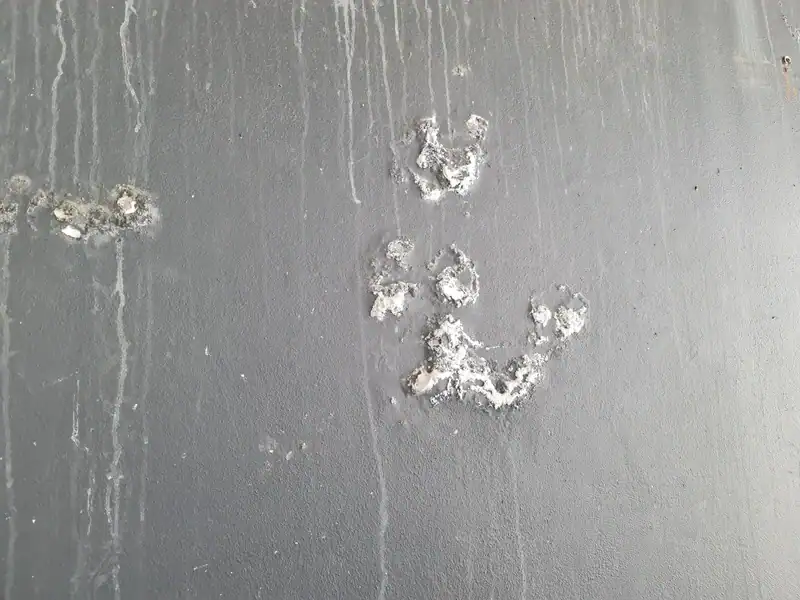
Roof-Garden Irrigation Fixings Were Allowing Water Into the Parapet Walls
The property included roof gardens with irrigation conduits secured to parapet walls by metal clamps.
The inspection found that water was entering around some of these fixing points.
This is the type of defect that can be easily missed if a repaint is priced only by measuring wall area. The hole around a fixing may be small, but water entering through it can move into surrounding plaster and later become visible as bubbling, staining or coating failure elsewhere on the wall.
The documented remedial scope therefore required the relevant clamps to be removed, the penetrations sealed with flexible polyurethane and the conduits secured again afterwards.
Ivy-Support Wall Plugs Created Another Water-Entry Route
A separate gable wall had ivy-support wires secured into wall plugs.
The wall-plug penetrations had not been effectively sealed against rainwater.
The project required the ivy, wires and relevant fixings to be removed so that the wall plugs could be sealed before the support system was reinstated.
The lesson is broader than ivy: exterior screws, brackets, lights, conduits and other wall-mounted fittings interrupt the protective skin of an exterior wall and should be assessed when nearby paint repeatedly deteriorates.
Why Moisture Readings Were Not Treated as a Diagnosis by Themselves
The 16%–33.5% readings confirmed that some tested areas were moisture-affected, but the meter alone did not explain why.
The physical inspection supplied the essential context: penetrations, cracks, failed seals, horizontal masonry and continuing ground-related conditions on some walls.
This is why our project pages record both the readings and the surrounding building evidence.
Alkali-Related Discolouration
Some discolouration was associated with moisture moving through cementitious surfaces and the resulting alkaline conditions.
When moisture transports soluble alkaline compounds toward a painted surface, the paint binder and pigments can deteriorate and the visible coating may lose colour or become unstable.
Applying another finishing coat over that condition does not remove the moisture route or improve the supporting substrate.
Horizontal Masonry Required Waterproof Preparation
Parapet tops, windowsills and wall tops receive direct rainfall and are more exposed to standing or slow-draining water than vertical façades.
Where these details are cracked or porous, water can enter from above and appear later as coating deterioration further down the wall.
The supplier-specified system included Dulux Rainshield on applicable prepared horizontal surfaces, with the recorded two-coat application applied in opposing directions.
Cracks Were Separated by Type
Hairline Cracks
Fine cracking received alkali-resistant preparation and flexible Rainshield treatment where specified.
Map Cracking
Areas containing multiple spider-web cracks received broader flexible waterproof preparation rather than each crack simply being hidden under a thick topcoat.
Wider Plaster Cracks
Wider cracks were opened where required, cleaned to sound edges and repaired with suitable masonry repair material before waterproof crack protection was applied over the prepared repair.
Expansion Joints and Failed Perimeter Sealants
Expansion joints were treated differently from static plaster cracks because they are intended to accommodate building movement.
Deteriorated joint material was removed where necessary and replaced with flexible polyurethane sealant.
Failed sealing around included windows and doors was also repaired where it presented a water-entry route.
Boundary and Garden Walls Had Explicit Moisture Limitations
The original project documentation is particularly useful because it does not promise that painting can permanently solve every moisture condition.
Some boundary walls lacked an effective damp-proof separation from ground moisture.
Where moisture continues migrating into masonry from below or behind, the accessible face can be prepared and protected, but a decorative coating cannot create a damp-proof barrier that does not exist within the structure.
The quotation therefore specifically excluded future moisture-related discolouration, bubbling or peeling caused by continuing damp from the relevant coating warranty conditions.
Foundation Walls Below Expansion-Joint Level
Moisture-related deterioration was also documented below weep-hole and expansion-joint level where some walls were exposed to moisture from the backfilled side.
Dulux Dampshield formed part of the specified preparation, but continuing migration from behind the wall remained an identified limitation.
Extensive Exterior Timber
Fascia boards, soffits, sprockets and sash-window timber were badly weathered in areas, with loose coating and exposed bare wood.
Loose coating was removed, sound edges feather-sanded and exposed timber spot-primed before the specified undercoat and finishing system were applied.
Dulux Pearlglo Waterbased formed part of the documented timber finish system.
Exterior Wall Coating Systems
Once water-entry details, preparation and repairs had been addressed, the final wall systems could be applied.
The recorded specification included Dulux WallClad to prepared main-building walls and Dulux Weatherguard Fine Textured to specified boundary and garden walls.
The product name was only one part of the project. The far more important work happened first: identifying water entry, cleaning, crack preparation, waterproofing, damp-related preparation, flexible sealing and timber restoration.
Completed Upper Bishopscourt Exterior
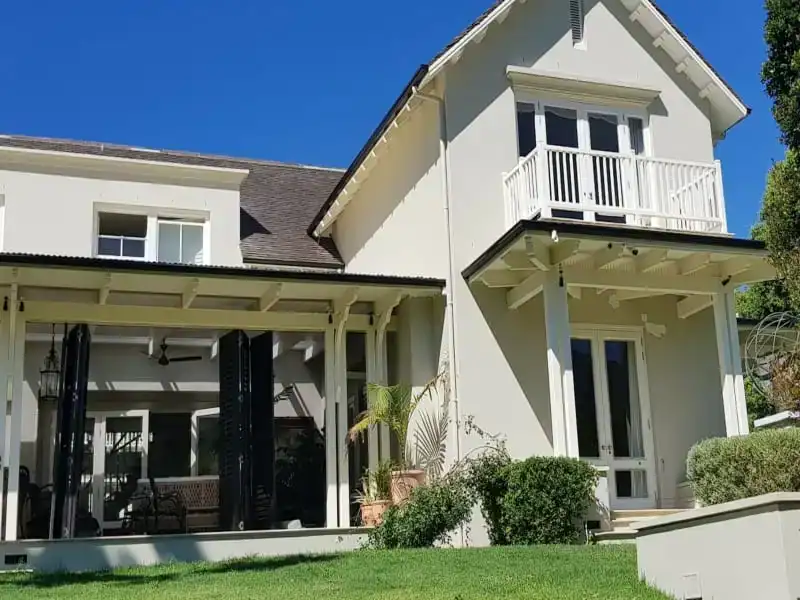
What This Upper Bishopscourt Project Demonstrates
The project shows why a large area of failed paint can sometimes originate from a very small building detail.
A wall fixing, screw hole, irrigation clamp or failed joint does not need to be physically large to allow significant quantities of rainwater into plaster over time.
The strongest part of this project is therefore not the final colour or even the 33.5% maximum reading. It is that actual water-entry routes were identified and incorporated into the remedial scope before the final coating system was applied.
The project documentation records Dulux technical involvement and supplier specifications. We do not infer a specific manufacturer-backed warranty duration beyond what is supported by the relevant written project documentation.
Related Bishopscourt Painting Services
Return to our Painters Bishopscourt page for the wider local service.
Related services include Exterior Painters Cape Town, Damp Proofing Cape Town, Residential Painters Cape Town and Estate Painting Cape Town.
Call 082 374 6862 or visit our contact page.
Original Painters Cape Town project photography. Image licensing information.
Helpful Painting Guides
Planning a Premium Home Repaint
Learn how access, gardens, glazing, valuable finishes and preparation should be coordinated on large high-value homes.
Damp Walls Before Repainting
Understand why water-entry routes, cracks, retaining walls, waterproofing and continuing moisture should be considered before paint is applied.
Why Paint Peels, Fades and Cracks
Learn why moisture, cracking, chalking and weak preparation can cause exterior coatings to fail prematurely.
Upper Bishopscourt Exterior Painting FAQs
When was the Upper Bishopscourt project completed?
The documented exterior project was carried out during February 2026, with the project period recorded as 9–25 February.
What moisture readings were recorded?
Protimeter readings across assessed exterior areas ranged from 16% to 33.5%.
What water-entry problems were identified?
Documented routes included unsealed roof-garden irrigation fixing points, ivy-support wall plugs, cracks, failed perimeter sealing, open expansion joints and vulnerable horizontal masonry.
Why can a small wall fixing cause substantial paint failure?
Water can enter through a small penetration and migrate through surrounding plaster before appearing as bubbling, staining or coating failure some distance away.
Was Dulux technically involved?
Yes. The project documentation records a Dulux specialist inspection and supplier painting specification because of the extent of the exterior deterioration.
Were boundary walls part of the project?
Yes. The original scope included main-building, roof-garden, boundary and garden walls, with separate moisture-related limitations documented for applicable boundary and foundation-wall conditions.
How were horizontal surfaces treated?
Applicable parapets, windowsills and wall tops received the specified waterproof preparation because horizontal masonry receives direct rainfall and can become a water-entry route.
How were expansion joints treated?
Deteriorated or open movement joints were prepared and resealed with suitable flexible polyurethane rather than treated as ordinary rigid plaster cracks.
Was extensive timber included?
Yes. The project included fascia boards, soffits, sprockets and sash-window timber requiring removal of failed coating, sanding, exposed-timber priming and compatible finishing systems.
Can paint permanently stop moisture entering a boundary wall from the ground?
No. Coating the accessible face cannot create a missing damp-proof barrier behind or beneath masonry where moisture continues entering from soil, backfill or ground contact.
Does Dulux involvement mean a particular manufacturer warranty is being claimed?
No specific manufacturer-backed warranty duration is claimed here beyond what is supported by the applicable written project documentation.
Where can I see your full Bishopscourt painting service?
Visit the Painters Bishopscourt page.

Copyright 2026 , all rights reserved.