Preparation-first painting for Newlands homes, older Newlands Village properties, Fernwood Estate homes, apartments, sectional-title buildings, roofs, damp-prone walls, timber and managed properties.
Newlands painting requires particular attention to winter moisture, leafy shade, mould and algae, older plaster, failed joints, windowsills, parapets, gutters, timber and slow-drying exterior walls. We diagnose these conditions before specifying the repaint.
27 years’ painting-contractor experience • Full-time employed painters • Working foreman on site daily • Written diagnostic reports • OUTsurance Public Liability Insurance
Interior and exterior painting for Newlands homes.
Older Newlands Village homes and moisture-sensitive plaster.
Estate homes including Fernwood Estate properties.
Apartments, sectional-title and body corporate buildings.
Roof painting and roof-condition assessment before coating.
Damp, mould, algae and moisture-related preparation.
Cracks, failed sealants, windowsills and parapet defects.
Timber windows, doors, fascia boards and exterior trims.
Schools, guesthouses, offices and managed properties.
Written diagnostic reports and detailed scopes of work.
Newlands Painting Based on Diagnosis, Preparation and Documented Local Experience
Newlands combines heavy winter moisture, mountain and forest influence, mature tree cover, shaded elevations, older plaster and vulnerable roofline and wall details. Our quotations therefore begin with the condition of the property rather than simply measuring how much paint will be required.
Documented Newlands Projects
This page documents genuine 2026 projects in Newlands Village and Fernwood Estate, including exact Protimeter ranges, observed defects, preparation, products and original project photographs.
Written Diagnostic Report
Every quotation includes a written diagnostic report recording relevant damp, mould, algae, cracks, failed coatings, sealants, timber, roofline defects and preparation requirements.
27 Years’ Experience
Painters Cape Town has 27 years of painting-contractor and surface-preparation experience across Cape Town, including older homes, estate properties, roofs, damp-related repairs and managed buildings.
Full-Time Employed Painters
Painting is completed by our full-time employed painters, not subcontracted painting teams. A working foreman is present on site daily to manage preparation, protection, workmanship and communication.
Newlands Moisture Awareness
Shaded walls, older masonry, windowsills, parapets, joints, gutters and rooflines are considered carefully because moisture can undermine a new coating even when a wall appears superficially ready for paint.
Direct and Insured Contractor
Painters Cape Town is a direct painting contractor, not a lead-generation company. Clients deal with the company responsible for the quotation, employed team, preparation and completed work. Public Liability Insurance is through OUTsurance.
Realistic coating-life guidance: where active moisture, mould, algae, cracks, failed joints, rust, weak previous coatings, timber deterioration and water-entry defects are correctly resolved, properly prepared paintwork can often maintain integrity for approximately 8–10 years. Suitable roof coatings can often maintain integrity for approximately 7–8 years where the roof is sound and the specified system is correctly applied. Any supplier or manufacturer warranty applies only where formally issued and remains subject to its written terms and exclusions.
Professional Painters in Newlands, Cape Town
Painters Cape Town provides preparation-first painting services in Newlands for established family homes, older Newlands Village properties, Fernwood Estate homes, apartments, sectional-title buildings, body corporate properties, rental homes, schools, guesthouses, offices, roofs, damp-prone walls, timber and exterior surfaces affected by moisture.
Newlands has a distinctive painting environment. Properties lie close to the eastern slopes of Table Mountain and the Newlands Forest environment, with mature trees, garden shade and wet winter conditions influencing how quickly exterior walls, roofs, plaster, timber and boundary walls dry. Paint failure therefore cannot be treated as a colour problem alone.
On Newlands properties we pay particular attention to moisture in plaster, slow-drying elevations, mould and algae, blocked or overflowing gutters, window and door joints, horizontal windowsills, parapets, roof-to-wall junctions, older paint layers, alkali-related deterioration, cracks, timber and vulnerable roof details.
The purpose of the inspection is to establish why an existing coating is deteriorating before a new coating is applied. A wall can look dry while still holding moisture. A crack can appear minor while allowing rainwater through a sill or parapet. Peeling paint can be the symptom of a failed previous coating, damp, alkalinity, poor adhesion or several problems acting together.
Our Newlands experience is documented on this page through two genuine 2026 projects: an older private home in Newlands Village where exact Protimeter readings ranged from 12% to 19%, and a private home in Fernwood Estate where exact readings ranged from 8% to 22%.
Why Painting in Newlands Requires a Different Approach
Newlands is not simply another Southern Suburbs location to which the same generic exterior specification can be applied. The combination of mountain proximity, substantial tree cover, winter rain, shaded garden elevations, older residential buildings and moisture-sensitive architectural details can make preparation more important than the finishing coat itself.
Wet Winters and Slow-Drying Exterior Walls
Exterior plaster does not necessarily dry at the same rate on every elevation. Walls receiving direct sun may dry comparatively quickly after rain, while shaded or south-facing walls near trees and gardens can stay damp significantly longer.
Residual moisture beneath a coating can contribute to bubbling, blistering, loss of adhesion, staining and repeated paint failure. This is why moisture-affected Newlands walls should be assessed rather than automatically scraped and repainted.
Protimeter readings are useful when interpreted together with visible defects and the position of the affected wall. A moisture reading does not by itself identify the source, but it can show why additional investigation and a moisture-aware specification are justified.
Newlands Forest, Mature Trees and Shaded Surfaces
Properties closer to the mountain and forest environment can have extensive tree cover and prolonged shade. The same greenery that defines Newlands can also reduce drying, allow leaves and organic debris to collect in gutters and encourage mould, algae and moss on walls and roofs.
Biological growth should be treated before repainting. Applying paint over mould, algae or contaminated surfaces can leave the new coating bonded to an unstable layer rather than to a sound substrate.
Gutters and downpipes also matter. Leaf debris can obstruct water flow, allowing gutters to overflow and repeatedly wet the plaster below rooflines. Repainting the damaged wall without attending to the route by which it becomes wet is unlikely to produce a durable result.
Newlands Village and Older Residential Properties
Newlands Village adds an important older-property dimension to painting in the suburb. Older houses can contain mature plaster, timber windows and doors, fascia boards, several generations of paint and previous repairs carried out at different times.
These surfaces need condition-based preparation. Old coatings may be chalky, poorly adhered or affected by moisture beneath the paint film. Plaster can contain cracks, salts or repaired areas with different porosity. Timber can have exposed sections where the previous coating has peeled away.
Our February 2026 Newlands Village project illustrates this clearly. The home required moisture assessment, removal of defective coatings, crack and joint repairs, fungal treatment, damp-related preparation, work to vulnerable horizontal surfaces and restoration of fascia boards before the finishing system was applied.
Fernwood Estate and Water Entry Through Modern Wall Details
A comparatively modern estate home can also experience moisture-related coating failure. Our May 2026 Fernwood Estate project showed that cracks around decorative plaster bands, failed sealants, windowsills and garage parapets can create localised routes for rainwater.
This is important because damp-related deterioration is not restricted to very old buildings. Different construction details create different vulnerabilities. An older masonry wall and a more modern plaster-band junction may both show peeling or discolouration, but the remedial work may be completely different.
The Fernwood Estate project therefore concentrated on diagnosing the position of moisture, treating failed coatings, repairing cracks, replacing failed sealants, waterproofing vulnerable horizontal surfaces and then applying the specified exterior system.
Alkali-Related Paint Deterioration
Moisture moving through cementitious plaster can carry alkaline compounds toward the painted surface. Where the coating system is vulnerable, this can contribute to discolouration, powdering, blotchy colour and eventual coating failure.
Our Newlands Village project contained areas of discolouration and deterioration consistent with damp-related alkali attack. These surfaces required more than an additional coat of exterior paint. Loose material had to be removed and affected areas prepared with products suitable for the observed substrate condition.
Windowsills, Parapets and Failed Sealants
Horizontal surfaces deserve particular attention in Newlands because rainwater can remain on cracked sills and parapet tops or enter through joints where sealant has failed.
Water entering at the top of a wall may later appear as bubbling or discolouration lower down. The visible paint failure is therefore not always located at the original water-entry point.
Cracked windowsills, parapet surfaces, failed joints around doors and windows, plaster-band junctions and expansion joints should be examined before exterior painting begins.
Newlands Property Types We Paint
The property mix in Newlands requires different approaches to inspection, protection, preparation, access and scheduling.
Newlands Village and older homes — older plaster, timber, previous coatings, damp-related deterioration and crack repairs may require particular attention.
Fernwood Estate and other private Newlands homes — modern plaster details, parapets, windowsills, sealants and landscaped surroundings require careful protection and defect-specific preparation.
Established family homes — full interior and exterior repainting, roof maintenance, timber, boundary walls and damp-prone rooms.
Apartments and sectional-title buildings — common-area protection, resident access, shared façades and written scopes for trustees or managing agents.
Body corporate properties — phased work, communication, common-area protection, roofs, façades, railings and boundary walls.
Rental properties — durable repainting for tenant changes and maintenance without concealing underlying damp or adhesion defects.
Guesthouses and managed accommodation — careful protection and practical scheduling around occupancy.
Schools and educational properties — phased or holiday-period work where practical.
Offices and medical suites — planned access, neat finishes and low-disruption scheduling where practical.
Painting Services in Newlands
Interior Painting in Newlands
Our Interior Painters Cape Town service covers Newlands houses, apartments, rental properties, guesthouses, common areas, offices and managed premises.
Interior painting can include walls, ceilings, cornices, doors, frames, skirtings, staircases, entrance halls, living areas, bedrooms, kitchens and bathrooms.
Bathrooms, kitchens and poorly ventilated rooms can develop mould where steam and humidity remain trapped against cold surfaces. Mould should be treated before repainting and the underlying ventilation or moisture conditions considered because a new topcoat alone cannot remove the cause.
Before painting begins, floors, furniture, fittings, cabinetry and other finishes are protected. Where an occupied home is being repainted, work can be phased room by room where practical.
Exterior Painting in Newlands
Our Exterior Painters Cape Town service includes exterior walls, older plaster, garden-facing elevations, parapets, windowsills, fascia boards, boundary walls, timber, gates, railings and other suitable exterior surfaces.
Preparation may include pressure washing, fungal treatment, removal of loose coatings, scraping, sanding, crack repairs, plaster repairs, joint resealing, chalk stabilisation, timber priming, rust treatment and substrate-specific primers.
Newlands exterior walls should not all be treated identically. A shaded, moisture-affected wall may need a different preparation sequence from a dry sun-facing elevation on the same home.
Roof Painting in Newlands
Our Roof Painters Cape Town service covers suitable tiled, cement-tile, concrete-tile, corrugated and IBR roofs after the roof condition has been assessed.
Before coating, relevant defects may include moss and algae, rust, cracked or slipped tiles, ridge-cap defects, flashings, gutters, roof-to-wall junctions and active leaks.
Roof painting is a protective coating process. It is not a repair for an active roof leak, broken tile, failed flashing, defective waterproofing or blocked gutter. Those issues should be addressed before the coating system is applied.
Where the roof is suitable, defects are corrected and the correct preparation and system are followed, roof coating can often maintain its integrity for approximately 7 to 8 years. Any supplier or manufacturer warranty applies only where formally issued and remains subject to its written terms and exclusions.
Damp-Related Preparation Before Painting
Our Damp Proofing Cape Town service is particularly relevant to Newlands because moisture can reach painted surfaces from several directions.
Possible routes include roofs, gutters, flashings, failed sealants, windowsills, parapets, cracks, rising moisture, condensation, boundary walls, poor drainage and water entering from behind or above a painted surface.
Paint does not fix active damp. If the moisture route remains active, a newly painted wall can develop staining, bubbling, blistering, mould or loss of adhesion again.
Some moisture conditions also carry limitations. Boundary walls, retaining walls, rising damp, unresolved drainage, active leaks and moisture entering from behind a coating must be assessed individually rather than being given an unrealistic blanket guarantee.
Residential Painting in Newlands
Our Residential Painters Cape Town service assists Newlands homeowners, landlords and property managers with interior painting, exterior painting, roofs, timber, boundary walls and preparation of damp-affected areas.
For a pre-sale or rental repaint, presentation is important, but defects should not simply be concealed. Painting directly over mould, damp plaster or poorly bonded coatings creates a cosmetic improvement without correcting the reason the previous finish failed.
These projects may involve shared façades, roofs, stairwells, passages, railings, garages, boundary walls and common areas. We provide written scopes so trustees and managing agents can understand the preparation, repairs, products, access arrangements, exclusions and coating work before approval.
Work can be phased around residents where practical, with protection of common areas and daily site clean-up.
Commercial, School and Guesthouse Painting
Our Commercial Painters Cape Town service assists suitable Newlands schools, guesthouses, offices, medical suites and managed premises.
Scheduling can be planned around pupils, guests, staff, tenants, access points and operating hours where practical. The same preparation-first principle applies: damp, mould, cracks, rust, failed coatings and roof defects should be assessed before the decorative finish is applied.
Common Paint and Moisture Problems We Find in Newlands
Peeling Paint on Older Plaster
Older plaster can carry several generations of paint, previous repairs and moisture-related deterioration. If the old coating has weak adhesion, new paint can detach together with the layer beneath it.
Bubbling and Blistering from Moisture
Bubbling or blistering can indicate moisture or vapour pressure beneath the coating. The wall should be investigated before the failed paint is simply covered.
Mould and Algae on Shaded Exterior Walls
Garden-facing, tree-shaded and south-facing surfaces can remain damp enough to support biological growth. These areas need suitable treatment and drying before repainting.
Moss and Algae on Roof Slopes
Roof sections receiving limited sun can accumulate moss and algae. Growth must be treated and removed during preparation so the roof coating bonds to the roof surface rather than to contamination.
Blocked Gutters and Roofline Damp
Leaves and debris can restrict gutters and downpipes. Overflowing water may then saturate plaster below the roofline and cause repeated staining, bubbling and coating failure.
Cracked Windowsills and Parapets
Horizontal masonry surfaces can admit rainwater when cracks or waterproofing defects develop. Repairing only the vertical paint failure below the defect leaves the water-entry point untreated.
Failed Window, Door and Expansion-Joint Sealants
Sealant eventually loses adhesion or flexibility. Failed joints around openings can allow water to enter behind plaster and paint, especially during prolonged winter rain.
Fine Cracks Around Decorative Plaster Bands
Where decorative bands or other plaster details meet the main wall, differential movement can create fine cracks. Our Fernwood Estate project demonstrated how these junctions can become localised water-entry points.
Alkali Discolouration and Powdering
Moisture moving through cementitious plaster can contribute to alkaline conditions at the coating surface, producing discolouration, powdering or failure where the existing paint system is vulnerable.
Rust on Gates, Railings and Metalwork
Active rust should be mechanically prepared and correctly primed before repainting. Applying topcoat over rust without suitable preparation normally leads to early failure.
Weathered Timber Windows, Doors and Fascias
Exterior timber requires sanding, repair and priming where necessary. Bare or poorly protected timber can absorb moisture and deteriorate beneath a failing coating.
Our Preparation-First Painting Process in Newlands
Physical site assessment — walls, plaster, roofs, gutters, timber, metalwork, joints, windowsills, parapets, boundary walls and previous coatings are inspected.
Moisture assessment where relevant — moisture readings are considered together with visible defects and possible water-entry routes.
Written diagnostic report — relevant damp, mould, algae, cracks, sealants, roof issues, timber defects, rust, coating failure and preparation requirements are documented.
Written scope of work — preparation, repairs, primers, finishing systems, access, protection, exclusions and limitations are recorded before work begins.
Defect correction — relevant cracks, failed joints, mould, algae, unstable coatings, rust and accessible water-entry details are addressed.
Cleaning and preparation — surfaces are washed, scraped, sanded, repaired, treated and primed as required by their condition.
Coating specification — the coating system is selected according to the substrate, exposure, moisture behaviour and intended finish.
Property protection — floors, furniture, paving, plants, glazing, architectural finishes and common areas are protected where applicable.
Daily working-foreman supervision — preparation, quality, protection and site organisation are supervised daily.
Daily clean-up — the work area is kept organised at the end of each working day.
Final inspection — completed work is checked against the agreed written scope before handover.
Property Protection and Site Management
Many Newlands projects involve established gardens, occupied houses, premium interior finishes, apartments or managed properties. Protection and access planning form part of the job rather than being treated as an afterthought.
Floors, furniture, cabinetry and fixtures are protected during interior work.
Paving, plants, gardens, glass, stonework and exterior features are protected where applicable.
Common areas and access routes are kept as clear as practical on sectional-title projects.
Work can be phased around residents, guests, staff or pupils where practical.
Ladders, materials and equipment are managed in an organised manner.
All painters are full-time employees of the painting contractor.
A working foreman is present on site daily.
Daily clean-up is completed throughout the project.
Why Choose Painters Cape Town in Newlands?
Painters Cape Town is a direct painting contractor. We do not collect enquiries and pass them to unrelated painting teams. The company quoting the project is responsible for the written diagnosis, scope, preparation, employed painters, supervision and final work.
27 years of painting-contractor experience.
Documented 2026 Newlands projects in Newlands Village and Fernwood Estate.
Exact moisture readings recorded on the documented Newlands projects.
Full-time employed painters, never subcontracted painting teams.
Working foreman on site daily.
Written diagnostic report with every quotation.
Clear written scope of work.
Preparation-first approach to damp, mould, algae, cracks, failed joints, alkali-related deterioration and weak coatings.
Experience with older homes and modern estate properties.
Interior, exterior, roof, damp-related, residential, body corporate and commercial painting capability.
Protection for homes, gardens, paving, furniture and existing finishes.
Supplier or manufacturer coating specifications followed where applicable.
Public Liability Insurance through OUTsurance.
Direct contact and direct accountability from quotation to handover.
Where moisture, mould, algae, cracks, failed sealants, rust, poor adhesion, weak previous coatings, timber deterioration and other relevant defects are corrected first, properly prepared paintwork can often maintain its integrity for approximately 8 to 10 years.
The important limitation is that paint cannot cure an unresolved building defect. Active damp, roof leaks, failed waterproofing, rising moisture, structural movement, water entering from behind retaining or boundary walls and unresolved drainage can continue affecting a coating until the cause is properly dealt with.
Real completed projects provide stronger evidence of local painting experience than a general list of services. The following two projects were completed by our full-time employed painters under daily working-foreman supervision during 2026.
Both projects involved physical inspection, moisture assessment and written preparation scopes before new exterior coatings were applied. They also demonstrate two different Newlands building situations: an older Newlands Village home with moisture-sensitive masonry and a Fernwood Estate home where water entry was associated with cracks, failed sealants, windowsills and parapets.
Newlands Village Exterior Painting and Damp-Related Preparation
Older private residential home | Exterior project | 9–20 February 2026
Project location: Newlands Village, Newlands, Cape Town Property type: Older single-storey private home Exact Protimeter range: 12% lowest reading to 19% highest reading Work completed: Exterior wall preparation and painting, moisture-related preparation, fungal treatment, crack repairs, failed-joint repairs, treatment of vulnerable horizontal surfaces and fascia-board restoration.
What We Found During the Newlands Village Inspection
The owner asked us to inspect and quote on repainting the exterior of the main building. The physical assessment found peeling coatings, visible moisture-related deterioration, areas of failed plaster, numerous cracks and discoloured paint.
These conditions showed that a straightforward scrape-and-repaint specification would not adequately respond to the existing substrate.
Exact Protimeter readings ranged from 12% to 19%.
Peeling and poorly bonded exterior coatings were present.
Moisture-related discolouration and deterioration were visible.
Areas showed symptoms consistent with damp-related alkali attack.
Numerous hairline and wider plaster cracks required attention.
Failed joints around openings created possible water-entry routes.
Windowsill and parapet-type horizontal surfaces required attention.
Fascia boards contained peeling coating and exposed timber.
Exact Protimeter Readings of 12% to 19%
The lowest exact Protimeter reading recorded was 12% and the highest was 19%.
The readings were considered together with visible paint deterioration and the condition of the older plaster. They reinforced the need for a moisture-aware preparation and coating system rather than treating every affected area as ordinary paint failure.
The age and condition of the property also meant that the walls needed to be treated realistically. Paint cannot install a missing damp-proof course or permanently stop moisture that continues moving through masonry. The preparation was therefore designed to remove failed coatings, treat accessible defects and use a more appropriate system for the observed wall condition.
Alkali Attack, Peeling Paint and Shaded Newlands Walls
Several blotchy and discoloured sections were consistent with damp-related alkali attack. Moisture passing through cementitious plaster can transport alkaline compounds to the painted surface, affecting the coating binder and colour and contributing to powdering or loss of adhesion.
Shaded walls in Newlands can remain damp after winter rain for longer than more exposed surfaces. Where moisture is also entering through cracks, wall tops, windowsills or failed joints, the deterioration can become more pronounced.
Crack Repair, Sealants and Horizontal Surfaces
Hairline cracks were treated with the specified alkali-resistant sealing and Dulux Rainshield system where appropriate. Larger plaster cracks were opened to a sound V-shaped joint, cleaned and repaired using a suitable masonry patching system before sanding and protection.
Cracked windowsills and parapet-type surfaces were treated as potential routes for rainwater. Failed sealant at accessible expansion joints and around openings was removed where required and resealed with Soudal single-component polyurethane sealant, with backing material used where gaps were too wide for sealant alone.
Fungal Treatment and Damp-Related Preparation
Dulux antifungal treatment was applied to affected surfaces and given the necessary contact time. Exterior walls were then high-pressure washed to remove grime, biological contamination, loose coating and dust.
Paint remaining poorly bonded after washing was removed manually rather than concealed beneath the new finish.
Affected powdery and alkali-damaged areas received the specified bonding treatment. Dulux Dampshield was applied to specified moisture-affected areas as part of the preparation system. It was not treated as a substitute for an unresolved source of moisture.
Preparation underway at an older Newlands Village home after moisture readings, peeling coatings, damp-related deterioration and plaster defects were identified.
Breathable Exterior Finish and Fascia Restoration
Two coats of Dulux Weatherguard were applied to the prepared main-building walls. The more breathable exterior finish formed part of the specification for the older moisture-affected masonry.
Loose paint was removed from the fascia boards, hard edges were feather-sanded and exposed timber received Dulux Wood Primer. A full coat of Dulux Universal Undercoat was applied where specified before the fascia boards were finished with two coats of Dulux Pearlglo Waterbased.
Completed Newlands Village Exterior
The completed appearance was only the visible final stage of the work. The durability of the repaint depended more heavily on what happened beforehand: moisture assessment, fungal treatment, removal of weak coating, crack repairs, joint sealing, treatment of vulnerable surfaces, stabilisation and timber preparation.
This Newlands Village project demonstrates why an older Newlands home should be assessed as a building rather than simply as a collection of square metres requiring paint.
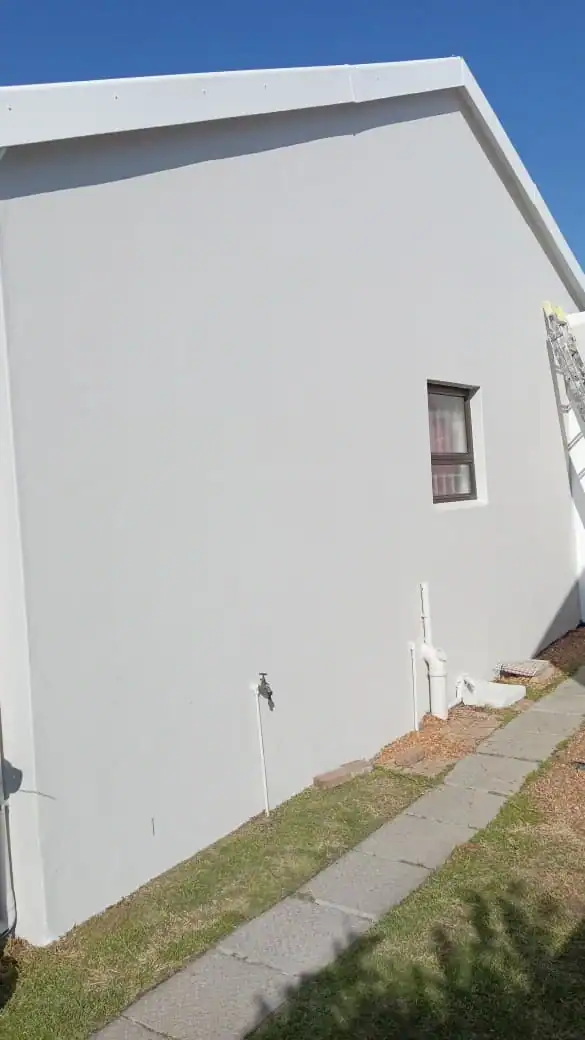
The completed Newlands Village exterior after moisture-related preparation, crack repairs, surface stabilisation and application of the specified coating system.
Fernwood Estate Exterior Painting, Crack Repairs and Waterproofing
Private estate home | Exterior project | 4–11 May 2026
Project location: Fernwood Estate, Newlands, Cape Town Property type: Private residential estate home Exact Protimeter range: 8% lowest reading to 22% highest reading Work completed: Exterior preparation and painting, treatment of damp and alkali-affected coatings, plaster crack repairs, resealing around windows, doors and expansion joints, waterproofing of vulnerable windowsills and garage parapets, and fascia preparation and painting.
What We Found at Fernwood Estate
The Fernwood Estate homeowner contacted us after a referral from a previous client. During the physical inspection, we found peeling exterior paint, damp-related discolouration, numerous plaster cracks, failed sealants and vulnerable horizontal surfaces.
The moisture readings varied considerably across the building, showing why individual elevations and wall details needed to be assessed rather than given one general preparation instruction.
Exact Protimeter readings ranged from 8% to 22%.
Peeling and deteriorating exterior coating was present.
Moisture-related discolouration occurred below some openings and joints.
Fine cracks were present around decorative plaster bands.
Failed sealants were identified around relevant windows, doors and joints.
Garage parapets and windowsills contained vulnerable horizontal surfaces.
Plaster cracks required different repair methods according to width and condition.
Exact Protimeter Readings of 8% to 22%
The lowest exact Protimeter reading recorded was 8% and the highest was 22%.
The higher readings coincided with areas of visible deterioration and helped establish why moisture-related preparation formed part of the written quotation.
The readings were not treated in isolation. Their significance depended on the wall position, visible defects, cracks, joints, horizontal surfaces and the likely routes through which water could reach the substrate.
Fine Cracks Around Decorative Plaster Bands
Fine cracking had developed around decorative plaster bands surrounding some window openings. Because the bands are separate plaster details applied against the primary wall surface, movement at the junction can create small cracks through which rainwater enters.
Visible discolouration below some windows and joints supported the need to treat these areas before repainting.
Failed Sealants Around Windows, Doors and Joints
Accessible failed sealant was removed and replaced with Soudal single-component polyurethane sealant where specified.
Resealing the relevant joints formed part of correcting the water-entry route rather than simply repainting the discoloured wall beneath it.
Garage Parapets and Windowsill Waterproofing
The garage parapets and vulnerable windowsills contained cracking and inadequate protection on horizontal surfaces. These details matter because rainwater can penetrate from above and later appear as paint failure down the vertical face.
The affected surfaces were prepared and treated with the specified Dulux Rainshield system before exterior topcoats were applied.
Preparation of Walls and Cracks
Mould-affected areas received Dulux antifungal treatment before the walls were high-pressure washed. Loose coating, dirt and contamination were removed, with poorly bonded paint scraped manually where washing alone did not remove it.
Hairline cracks received the specified sealing or crack-bridging treatment where appropriate. Larger cracks were opened, cleaned, repaired, sanded and protected before finishing coats were applied.
Damp-discoloured and powdery surfaces received the specified preparation and stabilisation products according to the observed condition.
Preparation in progress at Fernwood Estate after peeling paint, moisture-related discolouration, cracks, failed sealants and vulnerable wall details were identified.
Exterior Coating and Completed Fernwood Estate Finish
Once the repairs, sealant work, waterproofing and preparation had cured and dried sufficiently, two coats of Dulux Weathershield were applied to the specified exterior walls.
The fascia-board system included spot priming of bare timber with Dulux Wood Primer, Dulux Universal Undercoat where specified and two finishing coats of Dulux Pearlglo Waterbased.
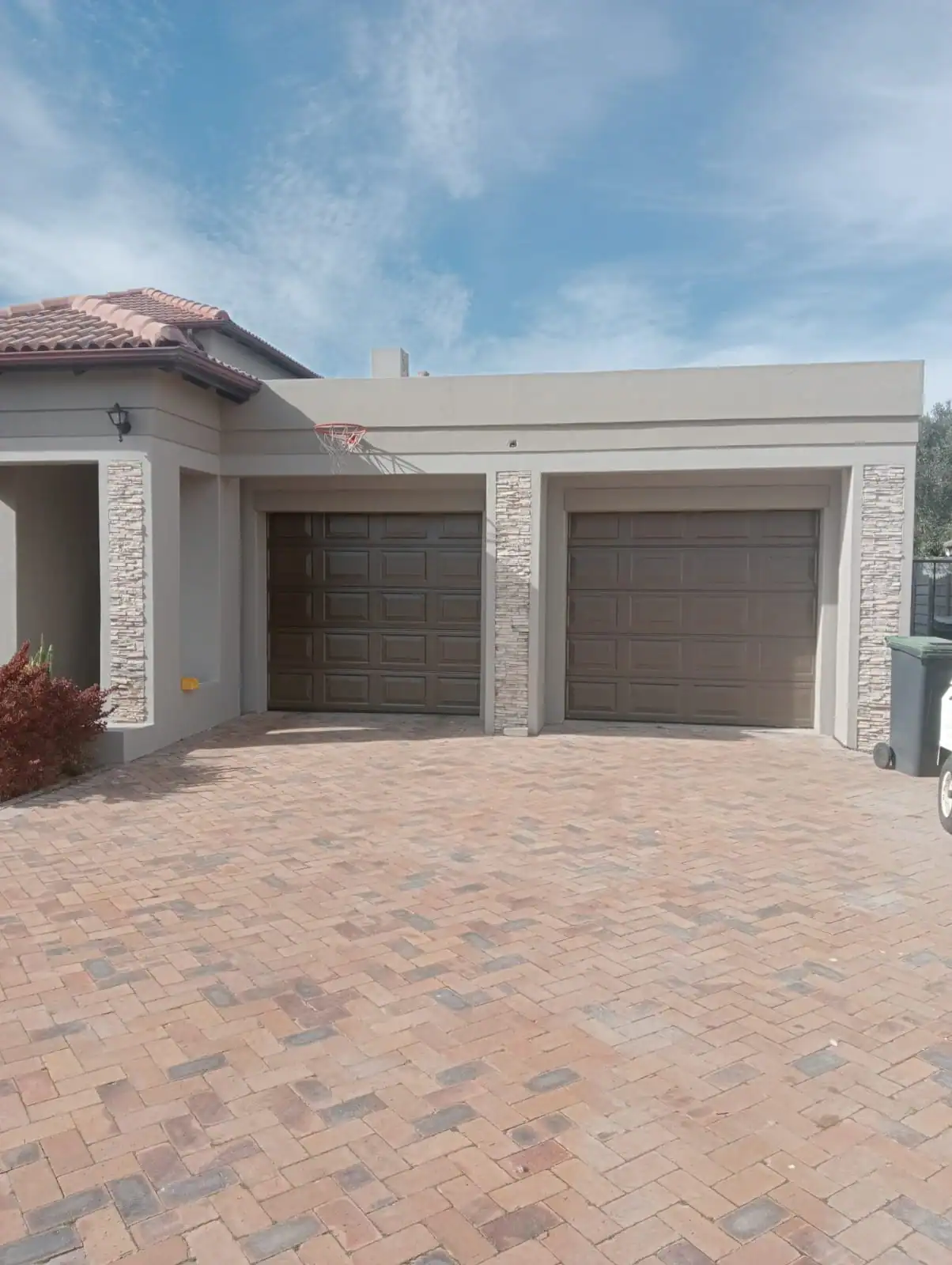
The completed garage elevation shows the decorative plaster bands, garage surrounds and stone-clad columns after the remedial work and coating system were completed.
The completed Fernwood Estate garage elevation after moisture-related preparation, crack and sealant repairs, waterproofing and exterior painting.
Why the Fernwood Estate Project Matters
The Fernwood Estate project demonstrates that moisture-related coating failure is not limited to older Newlands houses.
Fine cracking at plaster-band junctions, defective sealants, exposed parapet tops and cracked windowsills can allow water behind paint on comparatively modern homes.
The correct response is therefore defect-specific. A discoloured wall may require crack repair, joint resealing, waterproofing, substrate stabilisation, moisture-related preparation or a combination of these measures before repainting.
What These Two Newlands Projects Demonstrate
The two projects share the same preparation-first philosophy but they are not the same problem repeated twice.
Newlands Village involved an older home with moisture-sensitive masonry, alkali-related deterioration, peeling coatings, cracks, joints, horizontal details and weathered timber. The exact Protimeter range was 12% to 19%.
Fernwood Estate involved a different building type where plaster-band cracks, failed sealants, windowsills and garage parapets created important moisture-entry considerations. The exact Protimeter range was 8% to 22%.
Together, they demonstrate why Newlands painting should begin with inspection of the actual substrate and building details instead of assuming every wall failure requires the same generic repair.
These projects were completed by our full-time employed painters under daily working-foreman supervision. Clients dealt directly with Painters Cape Town throughout the work.
Original photographs on this page were taken in connection with Painters Cape Town projects. For image-use and licensing information, visit our Image Licensing page.
Request a Newlands Painting Quote
Whether you own an older property in Newlands Village, a Fernwood Estate home, an established family house, apartment, sectional-title property, rental, roof, damp-prone exterior or managed building, Painters Cape Town can inspect the surfaces and prepare a written diagnostic report and painting quotation.
These guides explain several of the preparation, moisture and property-protection issues that frequently matter when repainting Newlands homes and managed properties.
Damp Walls and Repainting
Learn why damp, waterproofing defects, shaded walls, boundary walls, timber and moisture sources should be assessed before repainting.
Newlands combines wet winters, mountain and forest proximity, mature trees, shaded walls, older plaster, roofs that can hold moss and vulnerable details such as windowsills, parapets and failed joints. Preparation therefore often requires moisture diagnosis, fungal treatment, crack repairs, sealant work and substrate-specific preparation before painting.
Do you have documented painting projects in Newlands?
Yes. This page documents two genuine projects completed by our employed painters in 2026: an older private home in Newlands Village from 9–20 February 2026 and a Fernwood Estate home from 4–11 May 2026.
What moisture readings did you record at the Newlands Village project?
Exact Protimeter readings ranged from 12% at the lowest measured point to 19% at the highest measured point. The readings were considered together with peeling coatings, damp-related deterioration, alkali discolouration, cracks, failed joints and the condition of the older plaster.
What moisture readings did you record at Fernwood Estate?
Exact Protimeter readings ranged from 8% at the lowest measured point to 22% at the highest measured point. Higher readings occurred in areas where moisture-related deterioration and vulnerable wall details required additional preparation.
Why does paint fail on shaded Newlands walls?
Shaded walls can dry slowly after winter rain and may remain damp longer than more exposed walls. Prolonged moisture can support mould and algae and can contribute to bubbling, peeling or loss of adhesion where the substrate is painted before it has been correctly treated and prepared.
Do Newlands homes need mould and algae treatment before repainting?
Where mould or algae is present, it should be treated before repainting. Painting over active biological growth leaves the new coating dependent on a contaminated surface and can shorten the life of the repaint.
Why is damp diagnosis important before painting in Newlands?
Damp can originate from roofs, gutters, cracks, failed sealants, windowsills, parapets, rising moisture, condensation, boundary walls or drainage. If the source remains active, repainting alone may only conceal the symptom temporarily.
What special preparation can older Newlands Village homes require?
Older homes can have mature plaster, accumulated paint layers, timber details, previous repairs, cracks and moisture-related deterioration. Preparation may include adhesion checks, removal of weak coating, crack repairs, fungal treatment, substrate stabilisation and correct priming before topcoats are applied.
Can newer estate homes in Newlands still have moisture-related paint failure?
Yes. Our Fernwood Estate project showed how fine cracks around decorative plaster bands, failed sealants, windowsills and garage parapets can allow water behind coatings even on a comparatively modern home.
Why are windowsills and parapets important before exterior painting?
Horizontal masonry surfaces can allow rainwater into a wall when cracks or waterproofing defects develop. Water entering from above may later appear as peeling, bubbling or discolouration on the vertical face below.
Can failed window and door sealants cause paint damage?
Yes. Failed sealant around windows, doors and expansion joints can create routes for rainwater to enter behind plaster and paint. The joint should be assessed and repaired where appropriate before the affected wall is repainted.
Can you repaint occupied homes and apartments in Newlands?
Yes. Floors, furniture, fittings and finishes are protected, and work can be planned room by room or in phases where practical. Daily clean-up is part of our normal site management.
Do you paint apartment blocks and body corporate buildings in Newlands?
Yes. We paint suitable apartment blocks, sectional-title buildings and body corporate properties with written scopes for trustees and managing agents, phased work where practical and protection of common areas.
Do you paint schools, guesthouses and offices in Newlands?
Yes. Suitable schools, guesthouses, offices, medical suites and managed premises can be painted with scheduling around pupils, guests, staff and normal operations where practical.
Do you paint roofs in Newlands?
Yes. We paint suitable tiled, cement-tile, concrete-tile, corrugated and IBR roofs after assessing relevant defects such as moss, algae, rust, broken tiles, ridge caps, gutters, flashings and active leaks.
Does roof painting fix active leaks?
No. Roof painting is a protective coating process. Active leaks, broken tiles, failed flashings, defective waterproofing and other roof defects need to be corrected before coating.
Can gutters cause paint failure on Newlands homes?
Yes. Leaf debris can obstruct gutters and downpipes, causing water to overflow onto walls. Repeated wetting below the roofline can lead to staining, bubbling, peeling and deterioration of plaster and paint.
Can boundary walls carry coating limitations?
Yes. Boundary and retaining walls can receive moisture from soil, rainfall, drainage or water entering from behind. Where moisture remains active, coating performance can be limited even after careful preparation.
Do you prepare timber windows, doors and fascias?
Yes. Exterior timber can require scraping, sanding, repair, priming and suitable finishing coatings. Bare or poorly protected timber should be correctly prepared before repainting.
Do you treat rust before painting metalwork?
Yes. Active rust should be mechanically prepared and correctly primed before finishing coats are applied. Painting directly over rust normally causes premature coating failure.
Do you use subcontracted painting teams?
No. Our painting work is completed by full-time employed painters. A working foreman is present on site daily to manage preparation, protection, workmanship and communication.
Are you a lead-generation company?
No. Painters Cape Town is the painting contractor responsible for the quotation, written scope, employed painters, preparation, daily supervision and completed project.
Are you insured?
Yes. Painters Cape Town carries Public Liability Insurance through OUTsurance.
How much painting experience do you have?
Painters Cape Town has 27 years of painting-contractor and surface-preparation experience across Cape Town and surrounding areas.
Do you provide a written diagnostic report?
Yes. Every quotation includes a written diagnostic report recording relevant defects and preparation requirements, which may include damp, mould, algae, cracks, failed joints, roof issues, old plaster, rust, timber defects and coating failure.
Do you provide a written scope of work?
Yes. The scope records the agreed preparation, repairs, primers, coating systems, access considerations, protection, exclusions and relevant limitations before work begins.
How long should properly prepared Newlands paintwork last?
Where active damp, mould, algae, cracking, failed sealants, rust, contamination, weak previous coatings and poor adhesion are correctly resolved first, properly prepared paintwork can often maintain its integrity for approximately 8 to 10 years.
How long can a suitable roof coating last?
Where the roof is sound, defects are resolved and the correct preparation and coating system are followed, roof coating can often maintain its integrity for approximately 7 to 8 years. Any supplier or manufacturer warranty applies only where formally issued and remains subject to its written terms and exclusions.
Which nearby Southern Suburbs do you also serve?
We also serve Bishopscourt, Constantia, Rondebosch, Claremont, Pinelands, Mowbray, Kenilworth, Wynberg, Plumstead, Tokai, Bergvliet and Kirstenhof, with individual suburb pages covering local painting conditions in greater detail.