Documented Newlands Painting Project
Newlands Village Exterior Painting Case Study
A documented February 2026 repaint of an older Newlands Village home where moisture, map cracking, failed seals, open movement joints, peeling coatings, mould and vulnerable horizontal masonry all had to be addressed before the finishing coats.
Protimeter readings ranged from 12% to 19%. The written specification included fungal treatment, pressure cleaning, alkali-related preparation, Dampshield, Rainshield waterproofing, several crack-repair methods, polyurethane sealing and explicit limitations for moisture-sensitive boundary and foundation walls.
Project Evidence
- Older private Newlands Village home.
- Documented 9–20 February 2026 project.
- Protimeter readings: 12%–19%.
- Main-building and boundary walls.
- Map or spider-web cracking.
- Hairline and wider plaster cracks.
- Peeling and badly weathered coating.
- Moisture-related discolouration.
- Alkali-related deterioration.
- Mould and damp-affected walls.
- Failed window and door sealing.
- Open expansion joints.
- Windowsill, parapet and wall-top waterproofing.
- Boundary-wall moisture limitations.
- Backfilled lower-wall moisture limitations.
- Nutec fascia boards and soffits.
- Working foreman: Patrick.
Real Newlands Village Project Evidence
12%–19% Readings
Measured moisture was interpreted together with cracking, failed seals, mould, coating deterioration and the construction of the affected walls rather than treated as a diagnosis by itself.
Several Crack Types
Hairline cracks, wider 1–5 mm plaster cracks and map cracking received different preparation instead of one generic filler system.
Water-Entry Details
Windowsills, parapets, boundary-wall tops, failed opening seals, expansion joints and exterior penetrations were included in the moisture-control scope.
Boundary-Wall Limitations
The quotation explicitly separated continuing ground or backfill moisture from ordinary coating-performance expectations.
Supplier-Specified Preparation
The written system included detailed cleaning, Dampshield, Rainshield, crack repair, flexible sealing and substrate-specific preparation before finishing coats.
Experienced Employed Team
The quotation records Paint Academy-trained painters with at least ten years' experience with the company, under working foreman Patrick.
Exterior Restoration at an Older Newlands Village Home
This documented exterior repaint was carried out at an older private home in Newlands Village between 9 and 20 February 2026.
Newlands Village contains an important mix of older residential architecture, including cottages, villas, semi-detached properties and terraced homes. Properties of this age can contain mature plaster, successive generations of coatings, previous repairs, timber or fibre-cement details and moisture conditions that require much more than a conventional scrape-and-repaint approach.
The physical inspection at this property recorded Protimeter readings ranging from 12% to 19%.
The important point, however, was not the meter reading on its own. The readings occurred alongside visible moisture-related deterioration, map cracking, numerous plaster cracks, failed window and door seals, open expansion joints, peeling paint, mould, discolouration and horizontal surfaces that were not adequately protected against water entry.
What the Original Inspection Actually Found
The full project quotation recorded:
- Protimeter readings between 12% and 19%;
- map or spider-web cracking;
- numerous cracks on walls, windowsills, parapets and other horizontal details;
- failed sealing around windows and doors;
- unsealed expansion joints;
- moisture-related discolouration;
- alkali-related coating deterioration;
- peeling and badly weathered paint;
- horizontal surfaces without adequate waterproof protection;
- mould and damp-affected walls;
- boundary walls exposed to continuing moisture; and
- lower wall sections exposed to moisture from the backfilled side.
That is a very different starting point from a quotation based only on wall area and paint quantity.
Newlands Village, Older Masonry and Moisture
Older walls can behave differently from newer cement-plaster construction.
Several generations of coatings and patch repairs may exist on the same elevation. Some sections can remain sound while others become powdery, damp-affected or poorly bonded.
Moisture can also arrive from more than one direction. Rain can enter through cracks, horizontal wall tops or failed seals, while ground-contact and backfilled walls can experience continuing moisture from below or behind.
This is why we do not use one moisture reading to label every affected wall as “rising damp”. The physical construction and water-entry details have to be considered as well.
The Preparation-Stage Condition
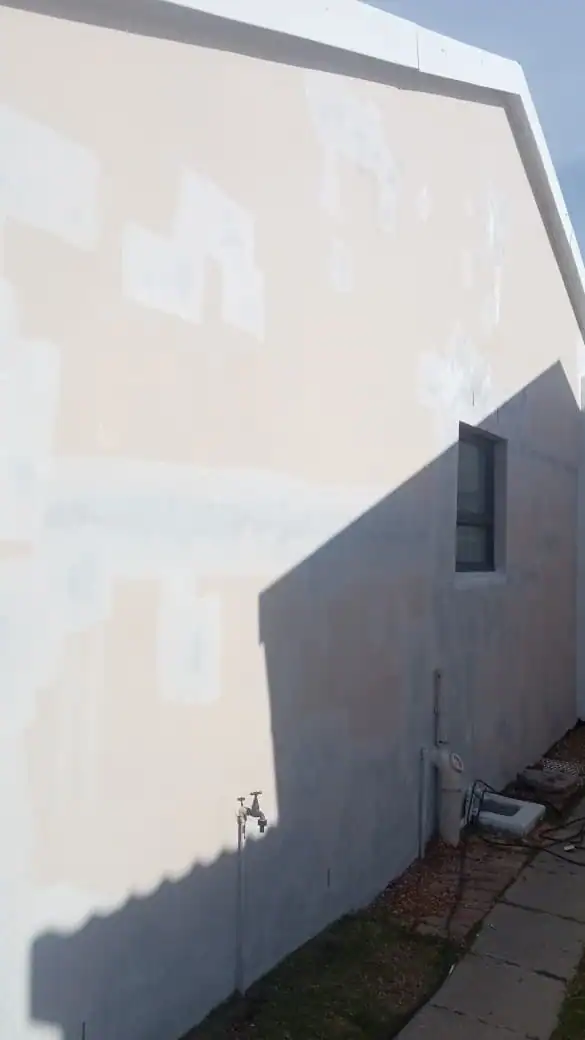
Why Alkali-Related Paint Deterioration Matters
The original inspection recorded discolouration associated with moisture and alkaline conditions in the plaster.
When moisture moves through cementitious materials, soluble alkaline compounds can reach the coating surface. Where the existing paint system is vulnerable, this can contribute to blotchy colour, powdering, binder deterioration and eventual coating failure.
The project therefore required more than another decorative topcoat.
Affected powdery surfaces received the specified bonding preparation before later coating stages.
Cleaning and Fungal Treatment
Exterior walls were prepared by high-pressure washing where suitable to remove loose and flaking coating, grime, chalky deposits and surface contamination.
Areas unsuitable for pressure washing could be cleaned manually with the specified cleaning solution.
Fungal treatment was specified for affected areas, including contamination inside cracks where required.
Painting over biological growth would simply leave the new coating dependent on a contaminated layer rather than on the sound substrate beneath it.
Waterproofing Windowsills, Parapets and Wall Tops
Horizontal masonry receives rain very differently from a vertical wall.
Windowsills, parapet tops and boundary-wall tops can hold water or receive direct rain impact. Fine cracks in these surfaces can allow water into the plaster, with the visible deterioration appearing later on the vertical wall below.
The written specification therefore required applicable prepared horizontal surfaces to receive two coats of Dulux Rainshield, with the second coat applied perpendicular to the first.
Damp-Related Priming Was More Detailed Than the Old Webpage Showed
The original quotation contains a particularly detailed damp-related priming system.
Prepared exterior surfaces received the specified Dulux Pre-Paint Dampshield treatment, with additional treatment to affected areas where required by the measured moisture condition.
Specified bare and damp-affected cementitious areas also received the additional Dampshield preparation recorded in the project scope.
This should not be interpreted as paint being able to repair an active leak or create a damp-proof barrier where none exists within the structure.
Hairline Cracks
Hairline cracks were not simply concealed under the finishing coat.
The written system specified alkali-resistant preparation followed by flexible Rainshield treatment worked into applicable fine cracks.
Wider 1–5 mm Plaster Cracks
Larger plaster cracks required a different system.
Where applicable they were opened into a suitable V-shaped joint, cleaned back to sound edges and repaired with compatible masonry patching material.
The repaired area was then sanded before receiving the specified flexible waterproof protection extending beyond the crack itself.
Map or Spider-Web Cracking
Map cracking involves networks of many fine cracks across a broader plaster area.
Trying to fill every individual line can miss the broader weakness.
The specification therefore called for flexible Rainshield preparation across applicable affected areas rather than treating the condition as a collection of isolated cracks.
Window, Door and Expansion-Joint Sealing
Failed sealing around windows and doors was identified as a possible route for moisture entry.
Deteriorated sealant was removed where required and applicable joints resealed with flexible single-pack polyurethane.
Expansion joints were also treated as movement details rather than filled like ordinary static plaster cracks.
Exterior wall and light fittings were included in the sealing inspection because penetrations through an exterior wall can allow water behind the coating system.
Boundary Walls — An Important Limitation
The original quotation specifically states that the relevant boundary walls did not have an effective damp-proof separation from ground moisture.
Moisture could therefore continue migrating into the masonry from below or behind.
The accessible painted face could be prepared and coated with the specified system, but decorative paint cannot create a structural damp-proof barrier inside a wall.
For this reason, future moisture-related discolouration, bubbling or peeling caused by continuing damp was expressly separated from ordinary coating-performance expectations.
Foundation Walls Below Weep-Hole and Expansion-Joint Level
The project also contained lower walls exposed to moisture from the backfilled side.
Moisture-related discolouration was visible below the relevant weep-hole and expansion-joint level.
Those surfaces were prepared and treated with the specified Dampshield system, but continuing moisture migrating through from behind remained an identified limitation.
This is a useful example of why a responsible painting quotation should explain what paint can and cannot solve.
Nutec Fascia Boards and Soffits
The original project quotation identifies the relevant fascia boards and soffits as Nutec.
Loose and flaking coating was removed, sound areas sanded and hard edges feathered before the specified full plaster-primer coat.
The prepared Nutec elements were then finished using the specified Dulux Roofguard system.
Exterior Wall Finish
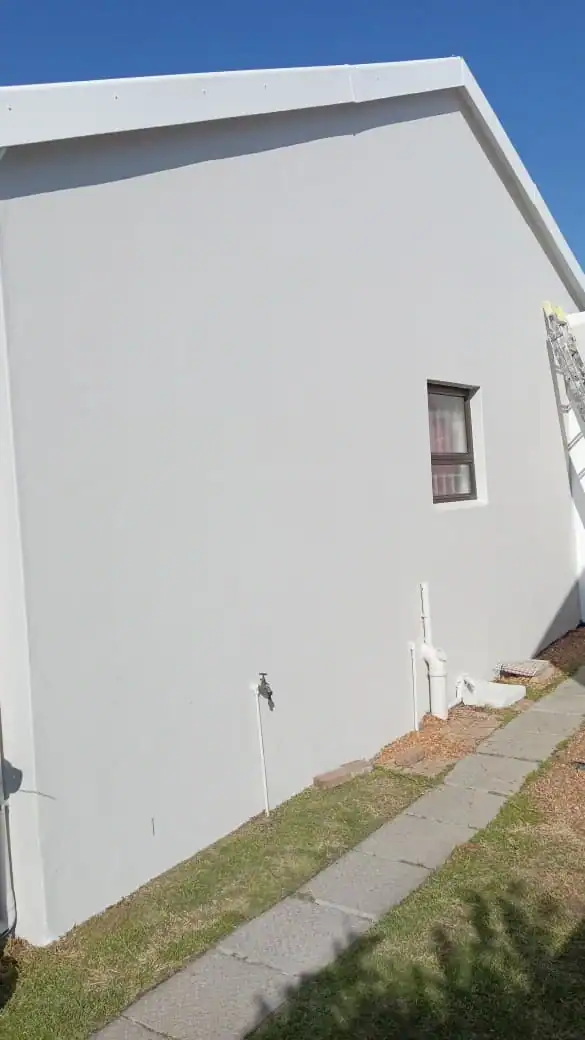
Once cleaning, fungal treatment, moisture preparation, crack repair, waterproofing and joint sealing were completed, the prepared main-building and boundary walls received the documented Dulux Weatherguard system.
The finishing paint was therefore the last stage of a much larger remedial process.
Completed Newlands Village Exterior
What This Newlands Village Project Demonstrates
This project shows why older Newlands properties should be assessed as buildings rather than merely as square metres of wall.
The visible paint failure was connected to several separate conditions: moisture-sensitive masonry, cracks, failed joints, unprotected horizontal details, biological growth, weak coating and continuing moisture on particular boundary and foundation walls.
Each defect required the appropriate preparation or limitation before the final coating system could reasonably be expected to perform.
Related Newlands Painting Services
Return to Painters Newlands.
Related services include Exterior Painters Cape Town, Damp Proofing Cape Town and Residential Painters Cape Town.
Call 082 374 6862 or visit our contact page.
Original Painters Cape Town project photography. Image licensing information.
Helpful Painting Guides
Damp Walls and Repainting
Learn why damp, boundary walls, failed waterproofing, cracks and continuing moisture should be assessed before repainting.
Why Paint Peels, Fades and Cracks
Understand how moisture, weak adhesion, cracking, chalking and poor preparation contribute to coating failure.
Planning a Detailed Home Repaint
See how access, preparation, gardens, paving, timber, windows and other finishes should be planned before work starts.
Newlands Village Exterior Painting FAQs
When was this project completed?
The documented exterior project was carried out from 9 to 20 February 2026.
What moisture readings were recorded?
Protimeter readings across assessed exterior areas ranged from 12% to 19%.
What defects were found?
The inspection recorded map cracking, numerous vertical and horizontal cracks, failed window and door seals, open expansion joints, moisture-related discolouration, peeling coatings, mould, damp-affected walls and horizontal surfaces requiring waterproof protection.
Did the moisture readings prove rising damp?
No. Moisture readings were considered together with wall construction and visible defects. Some walls also had specific continuing ground or backfill moisture conditions documented separately.
How were hairline cracks treated?
Applicable fine cracks received alkali-resistant preparation and flexible Rainshield treatment before the finishing system.
How were wider plaster cracks treated?
Applicable wider cracks were opened to a suitable repair profile, cleaned, patched with compatible masonry repair material and protected with the specified flexible waterproof system.
What is map cracking?
Map cracking is a network of many fine spider-web cracks across a plaster surface. Applicable affected areas received broader flexible preparation rather than each line simply being hidden with topcoat.
Were windowsills and parapets waterproofed?
Yes. Applicable horizontal masonry received the specified two-coat Rainshield waterproof preparation.
Were failed window and door seals repaired?
Yes. Deteriorated sealing was removed where required and applicable joints resealed with flexible polyurethane.
Why were the boundary walls treated differently?
The quotation identified continuing moisture from ground or reverse-side exposure. Painting the accessible face cannot create a missing structural damp-proof barrier within the wall.
What limitation applied to lower foundation walls?
Some lower wall sections were exposed to continuing moisture from the backfilled side. They were prepared and treated, but future deterioration caused by continuing moisture migration remained an identified limitation.
Were fascia boards and soffits included?
Yes. The documented project identifies the relevant fascia and soffit elements as Nutec and specifies preparation, priming and a compatible finishing system.
Where can I see your full Newlands service?
Visit the Painters Newlands page.

Copyright 2026 , all rights reserved.