Upper Bishopscourt Paint Failure
Real findings of water entry, 16% to 33.5% readings, cracked plaster, failed seals and remedial exterior preparation.
Bishopscourt Paint Failure Assessment
Why is paint peeling, bubbling, flaking or chalking on your walls? The correct repair depends on what caused the coating to fail.
Our February 2026 Upper Bishopscourt restoration documents actual water-entry defects, moisture-affected plaster, failed coatings and Dulux technical involvement.
With 27 years of experience, full-time employed painters and written diagnostic quotations, we assess the underlying condition before specifying repairs and repainting.
Peeling or bubbling paint: Inspect moisture, adhesion and previous coating condition.
Rainwater entry: Check parapets, windows, cracks, seals and fixing penetrations.
Failed plaster or cracks: Repair the substrate before applying new coatings.
Real Bishopscourt paint failure evidence
Practical experience assessing paint adhesion, moisture-related deterioration, cracks and ageing coatings.
Upper Bishopscourt exterior restoration documents actual paint failure and identified water-entry routes.
The exterior project recorded Protimeter readings of 16% to 33.5%, interpreted with physical findings.
A Dulux specialist inspected the documented exterior project and supplied a painting specification.
Defective coatings, cracks, contamination and relevant water-entry problems are assessed before finishing.
Full-time employed painters, working-foreman supervision and written diagnostic quotations.
Peeling and bubbling paint in Bishopscourt can result from moisture entering the substrate, incompatible previous coatings, weak adhesion, unsuitable primers, contamination or continuing movement in the building.
There is no single cause that applies to every property. A shaded exterior wall, an ageing interior ceiling and a lower boundary wall may show similar paint failure while requiring completely different repairs.
Painters Cape Town investigates the visible condition and prepares a written diagnostic quotation before specifying suitable remedial preparation and repainting.
Our approach is supported by original work in Upper Bishopscourt and Bishopscourt Village.
Our exterior restoration at a private Upper Bishopscourt home, completed from 9 to 25 February 2026, involved extensive deterioration of painted plaster, cracks, failed sealing and moisture-related coating problems.
Protimeter readings in inspected areas ranged from 16% to 33.5%. These were instrument readings considered alongside the physical defects, not laboratory moisture percentages or automatic proof of rising damp.
The inspection established that water was entering through roof-garden irrigation clamp fixings and unsealed ivy-support wall plugs. Failed perimeter seals, movement joints and exposed horizontal masonry also required attention.
This is an important lesson: a large patch of failed paint can originate from a comparatively small building defect.
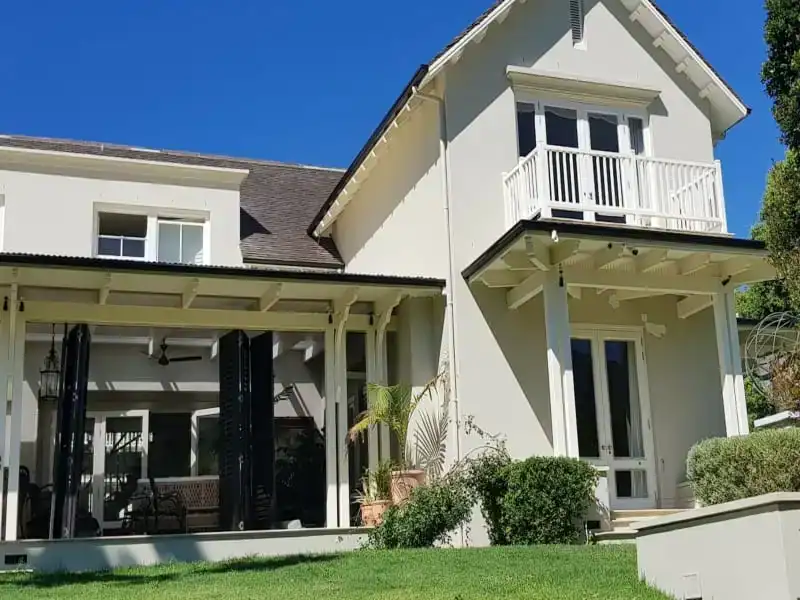
A Dulux specialist inspected the property, and the remedial painting followed a supplier-prepared specification. Identifying water entry and preparing the affected surfaces were essential before finishing coats could be applied.
View the complete Bishopscourt exterior paint failure case study
Bubbles or blisters form when the coating loses its bond or is affected by conditions beneath or within the paint film. Moisture is a common possibility, but application conditions, incompatible layers and contamination can also contribute.
Visible blisters should be assessed before removal. The location and underlying plaster condition help determine whether the problem involves water entering the building or a coating-adhesion issue.
Peeling occurs when one or more coating layers detach from the substrate or from each other. Possible causes include poor original preparation, old powdery paint, incompatible primers, contamination and moisture.
Painting over loose material does not create a sound bond. The defective layers need to be removed to an appropriate sound base.
Chalking is the powdery residue that can develop as some paint binders deteriorate through weathering. Severe chalking creates an unstable surface for subsequent coatings.
Cleaning, soundness assessment and appropriate preparation are required. Primer selection must follow the remaining substrate and coating condition.
Hairline cracks, wider plaster cracks and interconnected map cracking may be associated with ageing plaster, substrate movement, shrinkage or failure of previous layers.
Not all cracking is structural. However, persistent widening, displacement or recurring movement may require further assessment beyond a decorative repair.
On certain shaded or tree-covered elevations, moisture and reduced drying can favour biological growth. These deposits must be appropriately treated and removed before repainting.
Two homes built from the same architectural plans can develop different painting problems because of their original construction and coating systems.
One builder may have applied an unsuitable primer to raw plaster, while another used an appropriate alkali-resistant masonry primer. Years later, the first house may require much more extensive removal, adhesion assessment and re-priming.
New plaster, previously painted plaster, sound fibre cement, bare timber and metal do not all use the same primer. Substrate condition, curing and supplier compatibility must be considered.
The appropriate time is determined by the cause and the condition of the building.
If an active leak, defective parapet, failed joint or plumbing problem continues supplying moisture, repainting the damaged area may be premature.
Once the source has been addressed, affected surfaces must be assessed for drying, soundness, adhesion and suitability for the intended repair system.
For exterior work, suitable weather and product-specific application conditions are also necessary. The fact that one elevation is dry does not prove that a shaded wall elsewhere on the property is ready for coating.
We identify the affected surfaces, failure pattern, coating layers, visible defects and possible water-entry routes. Moisture readings or adhesion observations are incorporated where useful.
Depending on the findings, this may involve appropriate Bishopscourt waterproofing repairs, improved sealing, crack treatment or work by a specialist trade.
Loose, powdery or inadequately bonded coatings are removed as necessary. Sound layers are assessed for their ability to accept compatible preparation and repainting.
Cracks, damaged plaster and exposed surfaces are repaired using suitable materials. Static cracks, movement joints and moisture-affected substrates may require different approaches.
Applicable primers and coatings are selected for the prepared surface. Coating quantities, number of coats, spreading rates and drying intervals follow the agreed specification.
Yes. A repair may fail again if the original water source remains active, movement continues, old unstable paint was left beneath the new coating or the selected system was incompatible with the surface.
On boundary and retaining walls, moisture entering from soil or backfill can remain outside the corrective scope of painting the accessible face.
That is why our quotations distinguish the expected performance of properly prepared main-building surfaces from locations with continuing moisture or movement limitations.
Our May 2026 Bishopscourt Village interior project demonstrates a different situation.
A shower leak had already been addressed, but a nearby bedroom wall remained moisture-affected. Protimeter readings across the inspected interior ranged from 5.4% to 17%.
This illustrates why correcting the leak and preparing the previously affected painted wall are separate stages. The appropriate primer and coating should be selected only after considering the actual substrate condition.
The size of the visibly damaged patch is not the only cost factor.
Two similar walls may need very different amounts of stripping, drying time, crack treatment, waterproofing, plaster repair, primer and repainting. Difficult access, surrounding property protection and the extent of hidden or continuing defects can also change the scope.
We therefore inspect the actual building and prepare a written quotation instead of quoting a standard rate for peeling paint.
For suitable building waterproofing, visit Waterproofing Bishopscourt. For repainting external walls after appropriate repairs, see Exterior Painters Bishopscourt.
Our Bishopscourt interior painters page explains related preparation inside occupied homes.
Return to Painters Bishopscourt for the complete local painting service.
If paint is bubbling, flaking, chalking or repeatedly peeling on your property, the first step is to understand why the coating is failing.
Call 082 374 6862 or request a Bishopscourt painting quotation.
Real findings of water entry, 16% to 33.5% readings, cracked plaster, failed seals and remedial exterior preparation.
How parapets, joints, windowsills and wall penetrations can contribute to recurring paint failure.
Understand why different crack types need different preparation before decorative painting.
How defective exterior coatings are assessed, prepared, primed and repainted.
No. Water entry, previous coating failure, contamination and unsuitable preparation can produce similar symptoms. The actual cause needs assessment.
Not reliably. Loose or poorly bonded coatings must be removed or otherwise appropriately prepared before repainting.
Recurring water entry, continuing movement or unstable underlying coatings can cause repeated failure even after a cosmetic repair.
Yes. We assess visible defects and prepare a written diagnostic quotation explaining the recommended preparation and limitations.

Copyright 2026 , all rights reserved.