Damp Proofing Paarl for Homes, Estates & Damp Walls
Professional assessment and preparation of damp-affected walls, bubbling paint, discoloured plaster and moisture-sensitive masonry before repainting.
With 27 years of painting-contractor experience, we investigate visible damp symptoms before recommending a coating system. Our documented Nantes Street, Paarl project includes genuine before-and-after photographs, moisture readings and a detailed written preparation specification.
Our full-time employed painters work under experienced foremen. We explain the difference between penetrating moisture, damaged coatings and continuing ground-contact damp—and the limits of what painting can achieve.
Damp-related painting should begin with inspection, moisture observations and an understanding of the likely source—not another coat of paint over a damaged wall.
27 Years' Experience
Established painting-contractor experience with damaged plaster, coating failure and moisture-sensitive surfaces.
Nantes Street Case Study
Original before-and-after photographs supported by the May 2026 exterior redecoration quotation.
Recorded Moisture Readings
Nantes Street inspection readings ranged from Min 11.3% to Max 26.9%.
Visible Defect Assessment
We record bubbling paint, discolouration, cracking, mould staining, failed seals and weakened plaster.
Moisture Source First
Cracks, parapets, windowsills, joints, drainage and ground contact are considered before repainting.
Damp-Sensitive Preparation
Compatible primers and remedial coating systems are specified according to substrate conditions and supplier requirements.
Plaster & Crack Repairs
Unsound coatings and damaged plaster require suitable repair before decorative topcoats are applied.
Boundary-Wall Expertise
We explain the limits of breathable finishes where moisture continues entering from soil or backfill.
Honest Warranty Conditions
Continuing damp from inaccessible surfaces or missing damp-proof barriers is not promised away by paint.
Full-Time Employed Painters
Painting and suitable damp-related surface preparation are carried out by our employed teams, not subcontracted crews.
Written Diagnostic Quotations
Visible symptoms, proposed preparation, coating requirements and scope exclusions are documented.
Working-Foreman Supervision
Experienced working foremen coordinate substrate preparation, site protection and painting quality.
Moisture readings support an inspection but cannot independently identify every source of damp. A suitable remedial coating is not a substitute for correcting active leaks or installing a missing structural damp-proof barrier.
Professional Damp Proofing and Damp Wall Preparation in Paarl
Painters Cape Town provides inspection-led damp-related surface preparation and painting for homes, estate properties and suitable commercial buildings throughout Paarl.
Damp walls, bubbling paint, discoloured plaster and peeling coatings should not simply be covered with another coat of paint. The underlying moisture condition, existing coatings and stability of the plaster must be assessed before specifying repairs.
Our company has 27 years of painting-contractor experience. We use Protimeter readings as part of our diagnostic observations, supported by inspection of cracks, seals, exposed masonry, previous waterproofing, building junctions and other possible moisture-entry routes.
Our work is supported by genuine Paarl project documentation. The Nantes Street project from 2026 provides original before-and-after photographs, recorded moisture readings and a detailed quotation addressing moisture-related discolouration, defective seals, cracking and the limitations of painting boundary and foundation walls.
For our wider services, see Painters Paarl. This specialist page concentrates on the diagnosis and preparation of damp-affected surfaces before repainting.
The Nantes Street project provides a practical example of why damp-related paint failure requires more than cosmetic preparation.
Location: Nantes Street, Paarl Original quotation: 24 May 2026 Proposed working period: 1–11 June 2026, subject to approval Protimeter readings: Min 11.3%, Max 26.9% Project scope: Exterior redecoration, moisture-related preparation, crack repairs, waterproofing details, timber and steelwork, together with separately quoted corrugated-roof painting.
The written inspection recorded discoloured paint associated with moisture ingress, cracks on vertical and horizontal masonry, deteriorating window seals, mould-affected surfaces and coating deterioration.
The same quotation described ongoing moisture exposure at boundary walls and foundation-wall sections below expansion joints. These conditions were treated as specific limitations because surface coatings cannot prevent all moisture from entering from the ground or backfilled side.
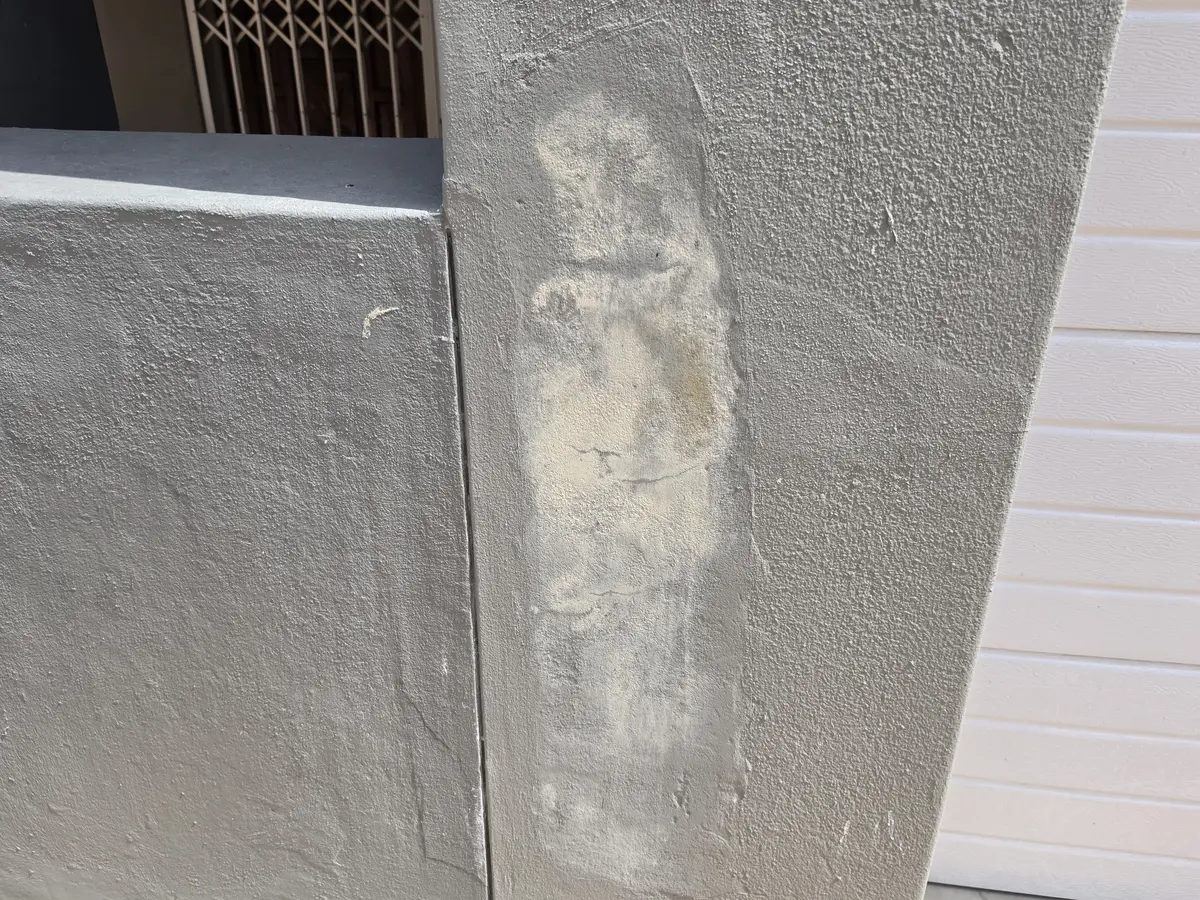
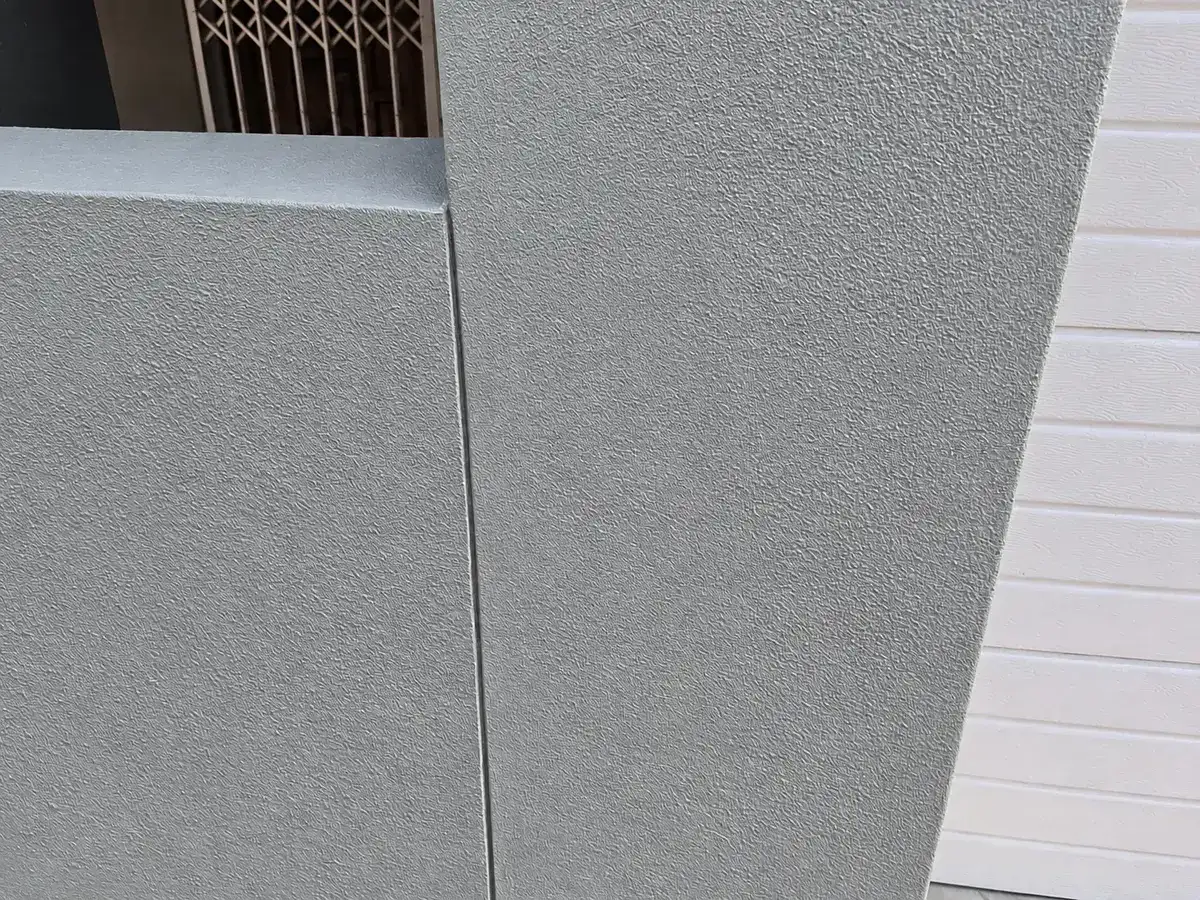
Damp-Affected Exterior Wall — Before and After
The original project photographs show a localised area of discolouration and uneven coating appearance on a grey textured exterior wall. The corresponding photograph shows the more uniform finish following preparation and repainting.
Before: Localised discolouration and patchy coating on the textured exterior wall at Nantes Street, Paarl. After: The same wall showing a uniform grey textured painted finish after preparation.
The photographs document the visible improvement. They do not independently establish the exact original moisture source or prove that moisture can never affect the wall again.
What the Nantes Street Inspection Identified
Protimeter readings: Min 11.3%, Max 26.9% across the inspected areas.
Discolouring coatings: Moisture-related paint deterioration identified in the written observations.
Failed window seals: Deteriorating sealant was recorded as a potential contributor to moisture entry.
Plaster cracking: Defects on main-building walls, parapets, windowsills and other vertical and horizontal surfaces.
Mould-affected areas: Surface growth or staining requiring appropriate cleaning and preparation.
Damaged plaster: Provision for removal and replacement of limited defective or hollow plaster.
Ground-contact walls: Continuing moisture migration at boundary walls and foundation walls below expansion joints.
These findings demonstrate why a moisture-affected wall must be considered as part of the building rather than as an isolated patch of paint.
Understanding Moisture-Related Alkali Attack
The Nantes Street quotation specifically identified alkali burn or alkali attack as a concern associated with moisture movement through cement-based plaster.
Where moisture carries alkaline salts toward the surface, certain coatings can lose colour, adhesion or overall film integrity. Discolouration below exposed masonry or near cracks can therefore be an important warning sign.
However, similar visible symptoms can arise from different causes. Discolouration alone is not proof of alkali attack, rising damp or a particular leak. The inspection should consider the building details and the condition of the substrate before a remedy is selected.
The Written Damp-Related Preparation Specification
The Nantes Street quotation described a preparation system involving the following work where applicable to the inspected surfaces:
Removal of loose or flaking paint, chalking, dirt and other unstable material.
Cleaning and treatment of affected surfaces before preparation.
Condition-specific treatment of hairline and wider plaster cracks.
Removal and replacement of defective or hollow plaster where included in the quoted allowance.
Replacement of deteriorated sealant at suitable windows, doors, joints and penetrations.
Waterproofing of suitable exposed horizontal masonry to reduce rainwater penetration.
Use of Dulux Pre-Paint Dampshield and other compatible preparation materials as set out in the written specification.
Subsequent exterior painting with a system appropriate to the prepared substrate.
The quotation also distinguished between moisture-sensitive walls that could receive specified remedial coating preparation and walls where continuing ground-contact moisture was expected.
These product details describe the original written specification. They are not a universal formula for every damp wall and do not mean that coating alone can eliminate an active moisture source.
Why Boundary and Foundation Walls Need Special Care
One of the most important findings in the Nantes Street quotation concerns moisture-sensitive boundary and foundation walls.
Where masonry has no effective damp-proof barrier separating it from ground moisture, water may continue entering the wall from below or from the backfilled side. The visible painted face is then only one part of the problem.
Boundary Walls Without an Effective Damp-Proof Barrier
Boundary walls can be exposed to damp soil, garden irrigation, saturated ground and moisture passing through untreated masonry. Even after careful preparation, continuing moisture can transport salts toward the painted surface.
For these conditions, a suitable breathable finish may be a more practical approach than an impermeable decorative coating. However, breathability does not create a missing damp-proof course or permanently stop moisture entering the masonry.
Foundation Walls Below Expansion Joints
The Nantes Street inspection also recorded discolouration below weep holes and expansion-joint level, where parts of the wall were exposed to moisture from the backfilled side.
The written quotation specified preparation and a damp-resistant primer system for the accessible surface, while explicitly excluding continuing moisture-related discolouration, bubbling and peeling from the relevant coating warranty.
This distinction is important: a correctly prepared and repainted wall can still develop moisture-related symptoms if water continues entering from behind it.
Why We Explain Warranty Exclusions
We believe property owners should understand these limitations before accepting a quotation.
Where a moisture source can be corrected and the substrate is suitable, a specified coating system can form part of a durable repair. Where moisture continues entering through an inaccessible or untreated surface, decorative painting cannot honestly be described as a permanent damp-proofing solution.
Further Damp-Related Evidence From Paarl Projects
The Nantes Street case is supported by additional inspections recorded in Paarl. These projects demonstrate different moisture readings and building conditions; they are not substitutes for inspecting an individual property.
Kaapse Draai, Courtrai
2026 — Min 8.7%, Max 26.5%
Inspection findings included map cracking, paint bubbling, moisture-related discolouration, failed seals and vulnerable parapet surfaces. The quotation distinguished building-wall preparation from moisture limitations at boundary walls.
Lemoenkloof
2026 — Min 1.4%, Max 17.9%
The documented exterior project involved moisture-related coating defects, cracks, failed joint seals and ageing horizontal waterproofing. The work required several different preparation systems.
Pearl Valley Golf Estate
2025 — Min 10.5%, Max 17.3%
An exterior redecoration quotation documented cracks, failed sealants, moisture-related discolouration, weathered coatings and horizontal masonry requiring waterproofing attention.
Paint can blister or lose adhesion when moisture moves through plaster or when the underlying coating is unstable. The affected surface must be assessed before deciding whether cleaning, plaster repair, moisture correction or different priming is necessary.
Discoloured Plaster and Alkali-Related Staining
Stains below windowsills, parapets and building junctions can point toward moisture movement. Alkaline salts, previous leaks and other coating defects may contribute to visible discolouration.
Soft, Hollow or Damaged Plaster
Water exposure can weaken plaster and its bond to the masonry. Where plaster is unsound, repainting without the required repairs may cause further failure. Defective plaster is removed and repaired where appropriate and included in the quotation.
Mould and Surface Growth
Mould staining can occur where surfaces stay damp or where ventilation and condensation conditions are poor. Suitable cleaning forms part of preparation, but persistent moisture or condensation may need separate attention.
Moisture Below Windows and Parapets
Failed seals, cracks, unprotected horizontal surfaces or defective junctions can allow rainwater into surrounding plaster. The original water-entry route should be considered before repainting the affected wall.
Ground and Backfill Moisture
Retaining walls, planters, foundation sections and boundary walls can be exposed to moisture from the opposite side. A surface treatment on the accessible face does not replace a suitable structural moisture barrier where one is required.
Penetrating Damp, Rising Damp and Condensation Are Not the Same
These terms describe different moisture mechanisms, so they should not be used interchangeably.
Penetrating damp: Moisture enters through defects such as cracks, seals, roofline details or exposed masonry and affects the adjoining building material.
Rising damp: Ground moisture moves upward through porous materials by capillary action where an effective barrier is absent or defective. Identifying it requires more evidence than a single moisture-meter reading.
Condensation-related damp: Indoor moisture collects on colder surfaces, sometimes contributing to mould or persistent surface staining.
Backfill or retained-soil moisture: Water moves into a wall from the side exposed to soil, which may not be accessible from the painted face.
Our inspection considers the visible symptoms and likely routes of moisture movement. Where a more extensive structural, plumbing or specialist diagnostic investigation is required, that should be addressed before relying on a decorative coating.
Damp Proofing and Waterproofing: Which Work Comes First?
Waterproofing and damp-related repainting can form part of the same repair project, but they do different jobs.
Waterproofing may address a vulnerable horizontal wall top, failed parapet or accessible masonry joint where rainwater is entering. Damp-related preparation concerns the affected plaster and coatings after the relevant water-entry problem has been assessed.
For suitable exposed masonry, our separate Waterproofing Paarl page explains the repair of parapets, windowsills, wall tops and failed sealants.
Damp-Related Preparation for Paarl Homes and Estates
Established Paarl Homes
Older plaster, previous coating layers, garden walls and exposed parapets can present a combination of damp symptoms and paint deterioration. Our Nantes Street and Lemoenkloof project records demonstrate real residential preparation requirements.
Courtrai and Larger Residential Properties
Complex building junctions, exposed elevations and different wall constructions may require separate inspection of moisture pathways and plaster conditions. Kaapse Draai provides documented Courtrai evidence.
Pearl Valley and Managed Estates
Estate properties can have distinct access and appearance requirements. Our Pearl Valley quotation documents moisture-related observations and preparation requirements for an estate home, without implying that every estate wall has the same defects.
Our Damp-Related Painting Process
Inspect the symptoms: Check peeling, bubbling, staining, mould, plaster damage and relevant building junctions.
Assess moisture: Record Protimeter observations where appropriate and consider their limitations.
Prepare the written quotation: Specify the included repairs, suitable primers, coatings and important exclusions.
Prepare the substrate: Remove unstable coatings, repair included plaster defects, clean affected areas and allow suitable drying or curing.
Apply the agreed system: Use appropriate preparation and finishing coatings on suitable surfaces under working-foreman supervision.
Inspect the finish: Review the completed work against the agreed scope and explain any remaining moisture-related limitations.
Our full-time employed painters carry out the suitable preparation and painting work rather than subcontracted painting crews.
How Much Does Damp Proofing Cost in Paarl?
Cost depends on the condition and area of affected plaster, accessibility, previous coatings, required crack repairs, defective seals, moisture assessment and whether the original water-entry source has been addressed.
A small area of suitable surface preparation can differ greatly from a wall with extensive hollow plaster, continuing backfill moisture or a defect requiring specialist structural work.
We provide a written quotation after inspecting the property and identifying the practical scope. We do not promise a permanent damp cure where the building condition does not support one.
Why Choose Painters Cape Town for Damp-Related Painting in Paarl?
27 years of painting-contractor experience.
Original Nantes Street before-and-after wall photographs.
Recorded project moisture readings and written inspection findings.
Additional experience documented in Lemoenkloof, Courtrai and Pearl Valley.
Condition-specific plaster, coating and crack preparation.
Clear distinction between moisture-entry repair and surface restoration.
Honest limitations for boundary and backfilled foundation walls.
Full-time employed painters and working-foreman supervision.
Written quotations describing the agreed scope and exclusions.
Request a Damp Wall Inspection in Paarl
If paint is bubbling, peeling or becoming discoloured, or you have cracks, moisture staining or damaged plaster, we can inspect the property and advise whether remedial preparation and painting fall within our suitable scope.
Call 082 374 6862 or visit our contact page to request an inspection and written quotation in Paarl.
Helpful Damp Proofing Projects & Guides for Paarl
Lemoenkloof Damp & Exterior Project
See genuine 2026 project evidence of moisture-related coating deterioration, recorded Protimeter readings, crack preparation and damp-resistant coating specifications.
Understand why failed waterproofing on parapets, windowsills and wall tops, together with defective seals, can allow moisture into surrounding plaster.
Explore how moisture movement, weak coatings, alkaline salts, cracks and inadequate preparation contribute to recurring paint failure on interior and exterior walls.
See original Paarl crack-repair evidence and understand why unstable plaster, opened joints and movement-related defects require appropriate preparation before painting.
Learn how ceilings, plaster walls, cornices and joinery are prepared, including the importance of assessing water stains and damp-affected surfaces before repainting.
Explore our established painting experience throughout Paarl, including completed residential projects, written diagnostic quotations and preparation-first painting services.
Do you repair damp-affected walls in Paarl before painting?
Yes, where the required work falls within our suitable preparation and painting scope. We assess visible damp symptoms, existing coatings, plaster condition and possible moisture sources before specifying repairs and a compatible coating system.
What damp-related problems did you find at Nantes Street in Paarl?
Our May 2026 inspection recorded moisture-related paint discolouration, cracks, deteriorating window seals, mould-affected areas and damaged coatings. Protimeter readings ranged from Min 11.3% to Max 26.9%. The project also documented moisture limitations at boundary and foundation walls.
Can damp-proof paint permanently stop rising damp?
No. A damp-resistant coating cannot replace a missing or failed structural damp-proof barrier. If moisture continues entering from the ground, suitable surface preparation may improve the painted finish but cannot guarantee that damp-related symptoms will never return.
Why does paint bubble or discolour on a damp wall?
Moisture movement, salts, unstable plaster, previous coating defects and inadequate preparation can contribute to bubbling, discolouration or loss of adhesion. The affected surface and likely moisture source must be assessed before choosing a repair system.
Do you use a Protimeter when inspecting damp walls?
Yes. We record relevant moisture observations using a Protimeter. Readings support our inspection but cannot independently prove rising damp or identify the exact source of water entry.
Do you use Dulux Dampshield for damp-related preparation?
Our original Paarl quotations include Dulux Pre-Paint Dampshield in specified preparation systems for suitable surfaces. Product selection depends on the substrate, moisture condition, manufacturer requirements and the written scope.
Can you repair plaster damaged by damp?
Yes, where included in the quotation and suitable for painting-contractor repairs. Unsound coatings and defective plaster may require removal and appropriate repair before priming and painting. Extensive structural or hidden damage may require separate specialist work.
Why does damp return on boundary and retaining walls?
Boundary and retaining walls may receive moisture from soil, irrigation or backfill, sometimes without an effective damp-proof barrier. A suitable breathable finish may be specified, but painting the exposed face cannot permanently stop continuing moisture from behind or below the wall.
What is the difference between damp proofing and waterproofing in Paarl?
Waterproofing addresses suitable exposed surfaces and joints where water may enter, such as parapets and windowsills. Damp-related preparation addresses damaged plaster and coatings affected by moisture. Some projects require both, with the moisture-entry issue considered before repainting.
How can I request a damp wall inspection and quotation in Paarl?
Call 082 374 6862 or visit our contact page. We inspect the property and prepare a written quotation identifying the suitable preparation, coating system and relevant limitations.