Nuutgevonden Estate • Stellenbosch
Exterior Painting at Nuutgevonden Estate, Stellenbosch
A documented July 2026 estate-home repaint involving 8.9%–14.2% Protimeter readings, severe exterior chalking, peeling coatings, crack repairs, failed movement joints, horizontal waterproofing and boundary-wall moisture limitations.
The main building and boundary walls required different preparation and coating approaches because exposed façades and moisture-sensitive boundary walls do not behave in the same way.
Nuutgevonden Estate Project Highlights
- Private residential estate home.
- Project period: 13–23 July 2026.
- Protimeter readings: 8.9%–14.2%.
- Main-building exterior walls.
- Exterior boundary walls.
- Severe fading and chalking.
- Peeling and blistering coating areas.
- Fine and wider plaster cracks.
- Failed movement-joint material.
- Windowsill waterproofing.
- Boundary-wall coping waterproofing.
- Chalky-surface stabilisation.
- Damp-related preparation where identified.
- Written boundary-wall coating limitations.
Documented Nuutgevonden Estate Painting Evidence
This project demonstrates why exterior painting should start with the condition of the existing coating and substrate. Chalking, peeling paint, cracking, vulnerable horizontal surfaces and boundary-wall moisture all required different preparation before repainting.
8.9%–14.2% Readings
Protimeter readings supplied measurable information about the assessed masonry and were considered together with the visible coating and moisture conditions.
Severe Chalking Addressed
Powdery exterior coatings were cleaned and stabilised where required instead of applying new paint directly over an unstable chalk layer.
Different Crack Types
Fine cracking and wider plaster defects received different preparation methods according to the size and condition of the defect.
Horizontal Waterproofing
Vulnerable windowsill tops and boundary-wall copings received dedicated waterproof preparation before the final wall coatings.
Boundary-Wall Limitations
The project recognised that coating the visible wall face cannot permanently stop moisture entering from soil, irrigation, the opposite face or below the wall.
Different Wall Coatings
The main-building walls and exterior boundary walls received different specified finishing systems based on their exposure and substrate requirements.
Full-Time Employed Painters
Painting was carried out by Painters Cape Town's employed team rather than subcontracted painting crews.
Direct Contractor Accountability
Clients deal directly with the contractor responsible for inspection, quotation, preparation, supervision and completed work.
Nuutgevonden Estate Exterior Painting Project in Stellenbosch
Painters Cape Town completed this documented Nuutgevonden Estate exterior painting project at a private residential home in Stellenbosch from 13 to 23 July 2026.
The project involved both the main building and exterior boundary walls.
The homeowner asked us to investigate peeling paint, severe surface chalking and recurring moisture-related deterioration before recommending the remedial painting work.
Protimeter readings across assessed masonry ranged from 8.9% to 14.2%.
The inspection showed that applying another cosmetic finish coat would leave several weaknesses underneath unresolved.
The project therefore required cleaning, removal of unstable coating, chalky-surface stabilisation, crack repairs, movement-joint preparation, waterproofing of exposed horizontal surfaces and cautious treatment of moisture-sensitive boundary walls.
To protect the homeowner’s privacy, no client name, street address or private map location is published.
This project provides genuine evidence supporting our Painters Stellenbosch, Exterior Painters Cape Town, Damp Proofing and Waterproofing and Residential Painters Cape Town services.
Nuutgevonden Estate Project Summary
- Location: Nuutgevonden Estate, Stellenbosch.
- Property type: Private residential estate home.
- Project period: 13–23 July 2026.
- Protimeter readings: 8.9% minimum to 14.2% maximum.
- Main scope: Exterior main-building walls and boundary walls.
- Primary defects: Chalking, peeling paint, cracks, failed movement joints and moisture-related coating deterioration.
- Waterproofing: Vulnerable windowsill tops and boundary-wall copings.
- Substrate preparation: Cleaning, loose-coating removal, stabilisation, crack repairs and damp-related preparation where appropriate.
What the Exterior Inspection Found
The condition of the property showed why exterior coating failure should be diagnosed before repainting.
- Severe fading and chalking on exposed exterior walls.
- Loose, blistering and peeling coatings in selected moisture-affected areas.
- Fine cracks requiring flexible preparation.
- Wider plaster cracks requiring more substantial repair.
- Failed expansion or movement-joint material at selected junctions.
- Unprotected horizontal windowsill surfaces.
- Unprotected boundary-wall copings exposed directly to rainfall.
- Boundary-wall moisture indicators requiring realistic coating limitations.
The existing project record confirms that the owner specifically requested investigation of peeling paint, surface chalking and recurring moisture-related deterioration, rather than merely asking for a colour change. :contentReference[oaicite:4]{index=4}
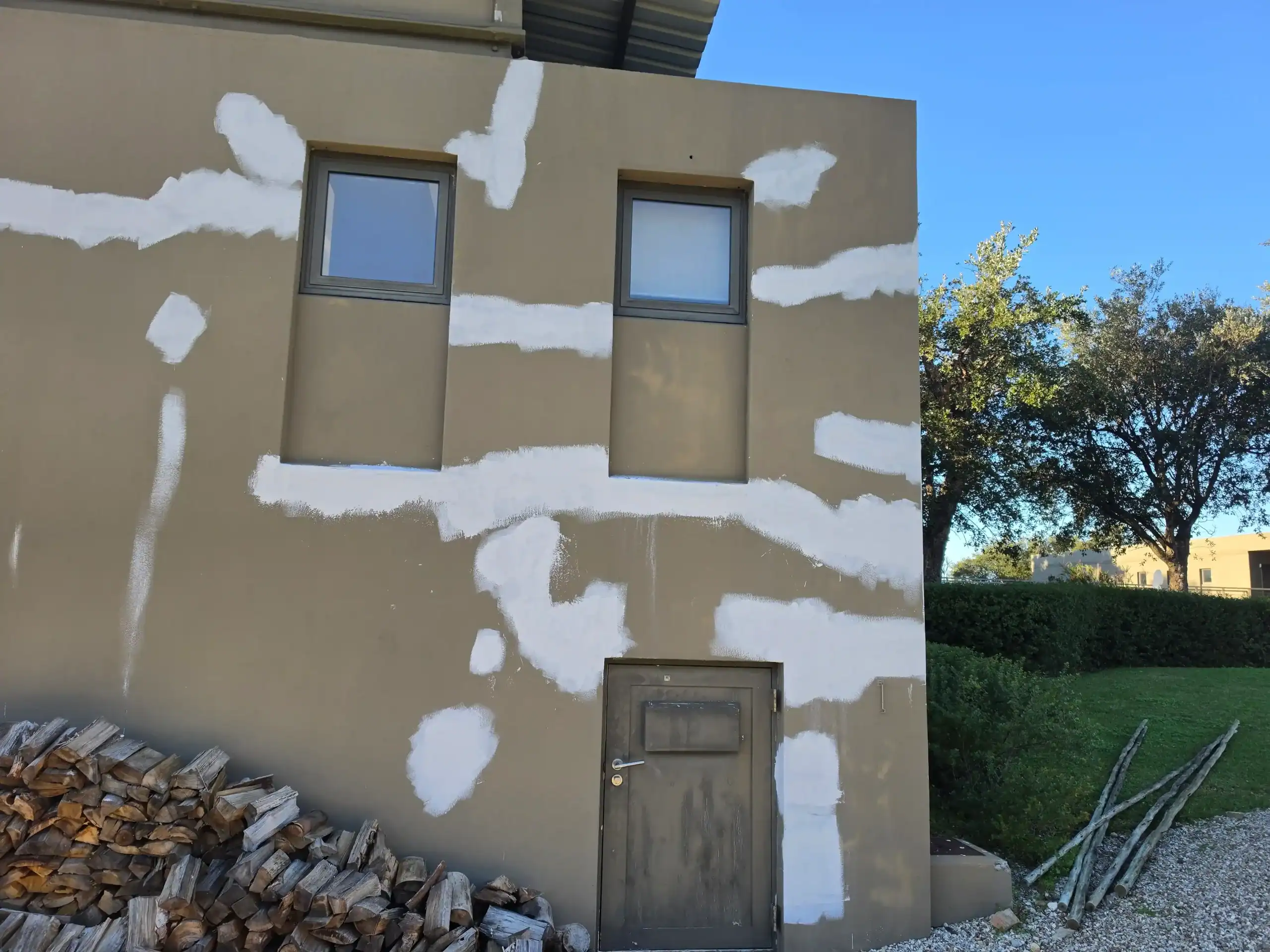
8.9%–14.2% Protimeter Readings
Protimeter readings taken during the assessment ranged from 8.9% to 14.2%.
These readings were used as one part of the inspection rather than as an automatic diagnosis of a particular type of damp.
The location of paint failure, cracks, wall tops, movement joints, windowsills, boundary walls, irrigation and surrounding ground conditions all matter when assessing how moisture may be affecting a coating.
This is particularly important on boundary walls because moisture may enter from below, from surrounding soil, from planted areas, from irrigation or from the opposite side of the wall.
Why Severe Chalking Matters Before Repainting
One of the strongest findings at this Nuutgevonden Estate property was the degree of chalking on exposed exterior coatings.
Chalking occurs when the existing coating weathers and leaves a loose powdery layer at the surface.
If a new coating is applied directly over that unstable powder, adhesion depends on the weak chalk layer rather than on a stable underlying surface.
Cleaning and stabilisation therefore become essential preparation stages before topcoating.
Cleaning and Removal of Unstable Exterior Paint
Exterior masonry was cleaned to remove dirt, biological growth, loose coating material and other surface contamination.
Areas where coating remained unstable were scraped and wire-brushed back to a firmer edge.
The objective was to remove material that could undermine adhesion of the new coating system.
Dulux Bonding Liquid on Remaining Chalking Areas
Where prepared exterior surfaces remained powdery after cleaning and removal of unstable coating, the specification included Dulux Bonding Liquid.
The purpose was to stabilise the remaining friable substrate and provide a more suitable base for subsequent paint layers.
This is particularly important on older sun-exposed exterior coatings where ordinary washing may remove loose surface chalk but still leave a weak underlying layer.
Fine Crack Preparation
Fine cracks were treated with the specified flexible preparation system.
The aim was to prepare and bridge suitable fine defects rather than simply conceal them beneath the decorative wall coating.
On exposed walls, fine cracks can become routes for winter rainfall if they extend through the protective coating and remain untreated.
Wider Plaster Crack Repairs
Wider plaster cracks required a different method.
Suitable defects were raked open to form an appropriate V-shaped joint and cleaned before compatible masonry patching material was installed.
The repairs were then finished and primed before subsequent waterproofing and finishing coats.
This distinction between fine cracks and wider defects follows the same preparation-first principle used throughout our documented Stellenbosch projects.
Movement and Expansion Joints
The inspection recorded failed movement or expansion-joint material at selected junctions.
A movement joint should not automatically be treated as though it were a static plaster crack.
Where building elements are designed or expected to move, the joint requires appropriate flexible detailing rather than a brittle rigid repair.
Waterproofing Windowsill Tops
Selected windowsill tops were exposed directly to rainfall and had insufficient protective waterproofing.
Horizontal masonry is more vulnerable than a vertical wall because water can remain on the surface instead of immediately running off.
The relevant windowsill surfaces received two coats of the specified Dulux Rainshield waterproof coating system.
The coats were applied in opposing directions to improve coverage across the treated horizontal surface.
Boundary-Wall Coping Waterproofing
The tops of exterior boundary walls were another important moisture-exposure detail.
Where wall copings remain unprotected, rainfall can enter through cracks or porous masonry from above and contribute to coating deterioration further down the wall.
Relevant coping surfaces therefore received the specified Rainshield waterproof preparation before the wall finishing system was applied.
Why Boundary Walls Need Different Expectations
Boundary walls are among the most difficult painted surfaces on many Cape properties because they may receive moisture from several directions.
Water can move upward from ground contact, enter from planted beds or irrigation, migrate through the rear face of the wall or enter through an exposed coping.
Painting the visible face of the wall cannot create a missing damp-proof barrier or stop moisture that continues entering from behind.
The Nuutgevonden Estate project therefore included realistic written limitations around boundary-wall coating performance.
This is preferable to promising that a decorative coating can permanently solve a building-envelope condition outside the coating system’s control.
Damp-Related Preparation Without Calling Everything Rising Damp
Dulux Dampshield was specified only in identified areas where it formed part of the appropriate remedial system.
It was not represented as a universal cure for active rising damp, leaking joints or moisture entering from behind boundary walls.
The existing project record specifically makes this distinction. :contentReference[oaicite:5]{index=5}
Main Building and Boundary Walls Required Different Finishes
One of the useful technical features of this project is that the main building and boundary walls did not receive the same final wall coating.
The documented specification recorded:
- Main-building exterior walls: two coats of Dulux Weathershield.
- Exterior boundary walls: two coats of Dulux Weatherguard Ultra Smooth.
- Chalking surfaces: Dulux Bonding Liquid where specified after cleaning and preparation.
- Damp-affected areas: Dulux Dampshield where identified and suitable.
- Fine cracks and exposed horizontal surfaces: Dulux Rainshield system.
The coating specification is documented in the original project material. :contentReference[oaicite:6]{index=6}
Why Boundary Walls Were Not Treated Like the Main House
The different finishing system reflects an important practical principle.
The main building and freestanding boundary walls experience different moisture conditions and have different construction details.
A main-building exterior wall is normally protected by the wider building envelope, while a boundary wall can remain directly exposed to rain from above, ground contact below and irrigation or planting along one side.
Using one identical specification everywhere would ignore those differences.
Stellenbosch Winter Rain and Summer Chalking
Stellenbosch exterior coatings experience two contrasting seasonal pressures.
Winter rain exposes cracks, wall tops, windowsills and joints to repeated wetting, while strong summer sun and UV exposure accelerate fading and surface chalking on exposed elevations.
The Nuutgevonden Estate project demonstrates both sides of this maintenance cycle: moisture-sensitive details required additional protection while the sun-exposed coating itself required cleaning and stabilisation before repainting.
Completed Nuutgevonden Estate Exterior
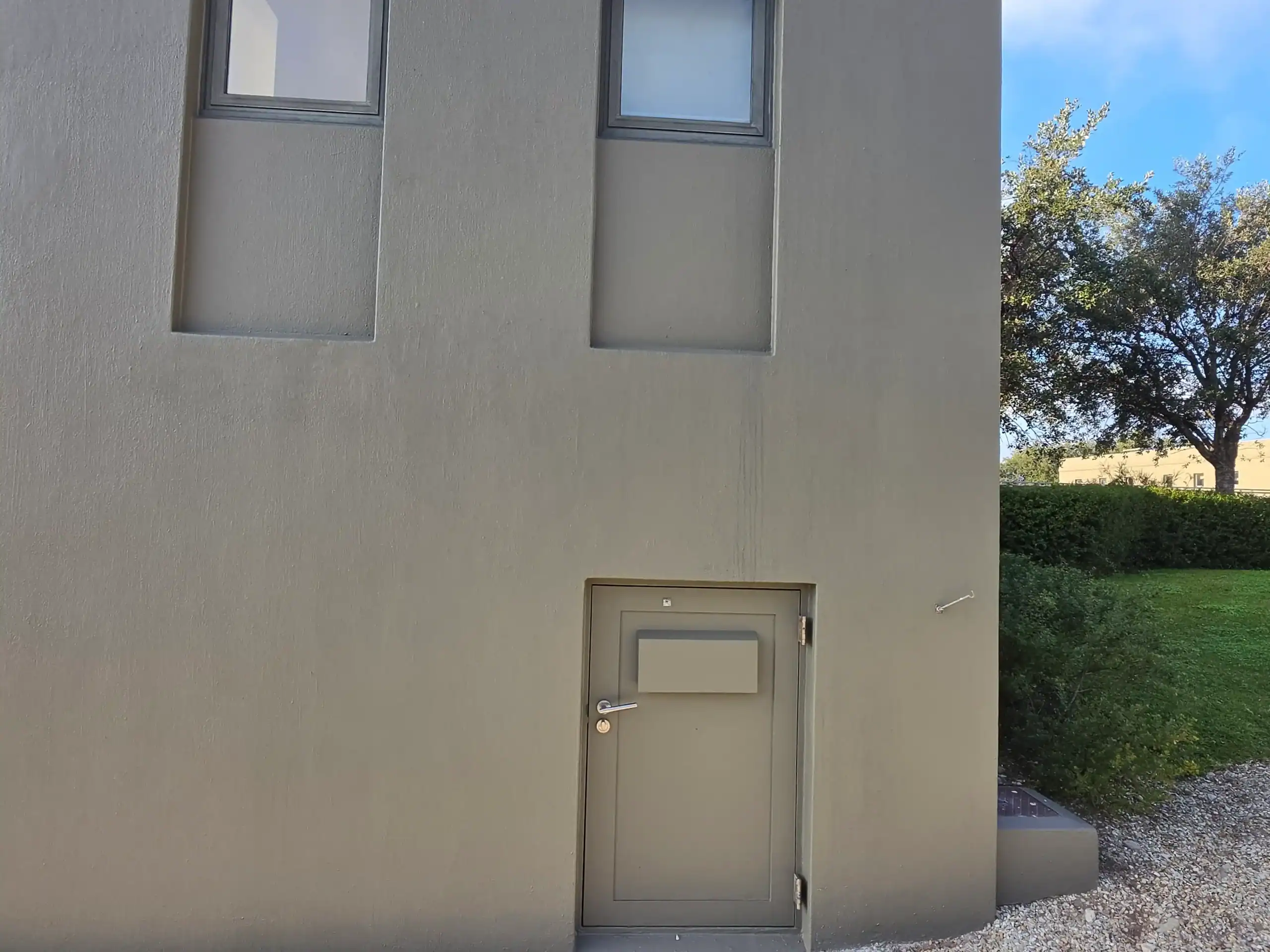
The completed project replaced a simple cosmetic repaint with a defect-led preparation process.
Loose coating was removed, chalky surfaces were stabilised where required, cracks were repaired, vulnerable horizontal surfaces received additional protection and the main building and boundary walls were finished using their respective specified wall systems.
The result was a cleaner and more consistent exterior built on a substantially better-prepared substrate.
What This Nuutgevonden Estate Project Demonstrates
- Severe chalking must be addressed before new exterior paint is applied.
- Moisture-meter readings assist diagnosis but do not identify every moisture source on their own.
- Fine cracks and wider plaster cracks require different repair approaches.
- Movement joints should not automatically be repaired with rigid filler.
- Horizontal windowsills and wall copings require dedicated waterproof protection.
- Boundary walls have different moisture risks from the main building.
- Painting only the visible face cannot stop continuing ground or rear-side moisture.
- Different substrates and exposure conditions can justify different wall-coating systems on the same property.
Three Different Stellenbosch Project Types
Nuutgevonden Estate adds a third distinct type of real project to our Stellenbosch authority cluster.
Our De Zalze exterior painting case study documents a premium double-storey estate home with 16.3%–21.5% moisture readings, cracks, failed seals, timber fascia boards, Nutec soffits and horizontal waterproofing.
Our Rozendal Farm exterior and roof painting case study documents a wine-farm and hospitality project with 11.3%–22.8% readings, exterior plaster, sash windows, timber and corrugated roof coating.
Nuutgevonden Estate demonstrates chalky-coating stabilisation, estate-home exterior painting, boundary-wall moisture limitations and different specifications for main-building and boundary walls.
Together these genuine projects support the broader Painters Stellenbosch page with first-hand technical evidence rather than generic location copy.
Related Stellenbosch Painting Services
- Exterior Painters Cape Town
- Damp Proofing and Waterproofing
- Residential Painters Cape Town
- Body Corporate and Estate Painting Cape Town
- Cape Winelands Painters
Preparation-First Estate Painting
Painters Cape Town has 27 years of painting and surface-preparation experience.
Our painting work is completed by full-time employed painters with working-foreman supervision rather than subcontracted teams.
We are not a lead-generation company. Clients deal directly with the painting contractor responsible for inspection, written observations, quotation, preparation, supervision and completed work.
Request a Nuutgevonden Estate Painting Quote
If your Nuutgevonden Estate or Stellenbosch property has chalking paint, peeling coatings, cracks, movement-joint failure, damp-related deterioration or vulnerable boundary walls and windowsills, the surfaces should be inspected before repainting.
Call 082 374 6862 or visit the Painters Cape Town contact page to arrange an inspection and written quotation.
Helpful Stellenbosch Painting Guides
Why Paint Peels, Fades and Cracks
Learn how UV exposure, chalking, moisture, cracking, poor adhesion and weak preparation contribute to exterior coating failure.
Damp Walls and Boundary Walls
Learn why irrigation, soil moisture, cracks, wall tops and continuing water entry should be considered before damp-affected masonry is repainted.
Planning a Premium Home Repaint
See why preparation, substrate condition, estate requirements, gardens, paving and property protection should be considered before substantial repainting begins.
Nuutgevonden Estate Exterior Painting FAQs
When was the Nuutgevonden Estate project completed?
The documented exterior project was carried out from 13 to 23 July 2026 at a private home in Nuutgevonden Estate, Stellenbosch.
What moisture readings were recorded?
Protimeter readings across assessed areas ranged from 8.9% to 14.2%.
What areas of the property were painted?
The project included the exterior walls of the main building and exterior boundary walls.
What problems were found before painting?
The inspection identified severe fading and chalking, loose or peeling coating, fine and wider plaster cracks, failed movement-joint material, vulnerable windowsill tops and boundary-wall copings, and moisture-related deterioration on selected areas.
Why is chalking a problem before repainting?
Chalking creates a loose powdery surface. New paint applied directly over that unstable layer may have poor adhesion, so cleaning and stabilisation can be required first.
How were chalky surfaces prepared?
Exterior surfaces were cleaned and unstable material removed. Where the prepared substrate remained powdery, Dulux Bonding Liquid was used where specified.
How were wider cracks repaired?
Suitable wider cracks were raked open, cleaned and repaired with compatible masonry patching material before finishing, priming and subsequent coating.
How were fine cracks treated?
Fine cracks received the specified flexible preparation system rather than simply being covered by the decorative wall finish.
How were windowsill tops waterproofed?
Relevant horizontal windowsill surfaces received two coats of the specified Dulux Rainshield system, applied in opposing directions for coverage.
Were boundary-wall tops waterproofed?
Yes. Relevant exposed boundary-wall coping surfaces received the specified waterproof preparation before the final wall coating.
Why are boundary walls more difficult to paint successfully?
Boundary walls can receive moisture from soil, irrigation, planted beds, the rear face of the wall and rainfall through the wall top. Painting the visible face cannot stop a continuing moisture source behind or below it.
Was Dulux Dampshield used?
Yes, but only in identified areas where it formed part of the project specification. It was not presented as a cure for active leaks, continuing rising damp or moisture entering from behind boundary walls.
What finish was specified for the main-building exterior?
The main-building exterior walls were specified for two coats of Dulux Weathershield after preparation.
What finish was specified for the boundary walls?
The exterior boundary walls were specified for two coats of Dulux Weatherguard Ultra Smooth.
Why were different paints used on the main building and boundary walls?
The surfaces have different construction and moisture-exposure conditions. The specification was therefore matched to the different wall types rather than using one identical system everywhere.
Does a moisture reading prove rising damp?
No. Moisture readings provide useful substrate information but should be interpreted together with the position of the damage, surrounding construction and possible moisture routes.
Can boundary-wall coating failure return?
Yes. If water continues entering from soil, irrigation, behind the wall or below the painted surface, bubbling, staining or peeling can return despite correct preparation of the visible face.
Do you use subcontracted painting teams?
No. Painters Cape Town uses full-time employed painters with working-foreman supervision.
How do I request a painting quotation in Nuutgevonden Estate?
Call 082 374 6862 or visit the Painters Cape Town contact page to arrange a physical inspection and written quotation.

Copyright 2026 , all rights reserved.