Documented Muizenberg Project • March 2026
Muizenberg Village Exterior Painting
Supplier-specified exterior restoration of an older double-storey coastal home in Muizenberg Village, with recorded masonry moisture readings of 19%–37% WME and extensive preparation of plaster, cracks, joints, timber and steelwork.
A Dulux paint specialist inspected the property and prepared the detailed project specification before work proceeded. The house had reportedly last been painted approximately twenty years earlier and required substantially more than a routine repaint.
Project Evidence
- Muizenberg Village, Cape Town.
- Older double-storey coastal home.
- Completed 2–13 March 2026.
- 19%–37% WME masonry readings.
- Dulux paint-specialist inspection.
- Detailed supplier-prepared specification.
- Approximately 20 years since previous repaint.
- Cracks, failed seals and open expansion joints.
- Horizontal waterproofing and damp-related preparation.
- Timber and steelwork restoration.
- Working foreman: Riaan.
Real Muizenberg Project Evidence — Not a Generic Location Page
This case study is based on a genuine 2026 Muizenberg Village repaint, with documented moisture readings, a supplier-prepared Dulux specification, original project photographs and a detailed preparation scope covering masonry, waterproofing, timber and steelwork.
19%–37% WME Readings
A Dulux paint specialist recorded masonry moisture readings between 19% and 37% WME. These readings were considered together with visible cracking, failed seals, open joints and moisture-related coating deterioration.
Dulux Specialist Specification
The property was inspected by a Dulux paint specialist and the remedial painting work proceeded to a detailed supplier-prepared specification rather than a generic exterior repainting scope.
Approx. 20-Year Coating Cycle
The older Muizenberg Village home had reportedly last been painted approximately twenty years earlier, leaving extensive deterioration across masonry, timber and steelwork to assess and prepare.
Preparation Before Paint
The project addressed loose and powdery coatings, mould, cracking, failed seals, open expansion joints, exposed horizontal surfaces, weathered timber and deteriorating steel coatings before finishing coats were applied.
Approved by Major Paint Suppliers
Painters Cape Town is approved by major paint suppliers and can work to formal supplier specifications where substrate condition, moisture or coating failure justifies technical involvement.
Written Warranty Conditions
This was a redecoration project completed to a formal supplier specification. Any coating warranty, exclusions and maintenance requirements remain governed by the written supplier specification rather than a blanket warranty claim.
Experienced Employed Painters
The project documentation records Paint Academy-trained painters with at least ten years' experience with the company. Our painters are employed by us rather than supplied as subcontracted crews.
Working Foreman: Riaan
Riaan supervised the project as the working foreman, assisting with painting while overseeing preparation, workmanship, property protection and daily site organisation.
27 Years' Contractor Experience
Painters Cape Town has 27 years of painting and surface-preparation experience across Cape Town homes, coastal buildings, estates, roofs, interiors and exterior restoration work.
Direct Painting Contractor
Painters Cape Town is not a lead-generation or quote-comparison service. Clients deal directly with the contractor responsible for inspection, quotation, employed painters, supervision and completed work.
OUTsurance Public Liability
Our painting work is supported by Public Liability Insurance through OUTsurance for additional accountability on residential and commercial projects.
Original Project Photography
The preparation and completed-project photographs on this page come from the actual Muizenberg Village project and document the condition and outcome of the work.
Documented Exterior Painting in Muizenberg Village
This case study documents a genuine Muizenberg Village exterior painting project completed at an older double-storey coastal home in March 2026.
The property was situated in the older Village environment close to False Bay and represented a very different maintenance challenge from a newer suburban home.
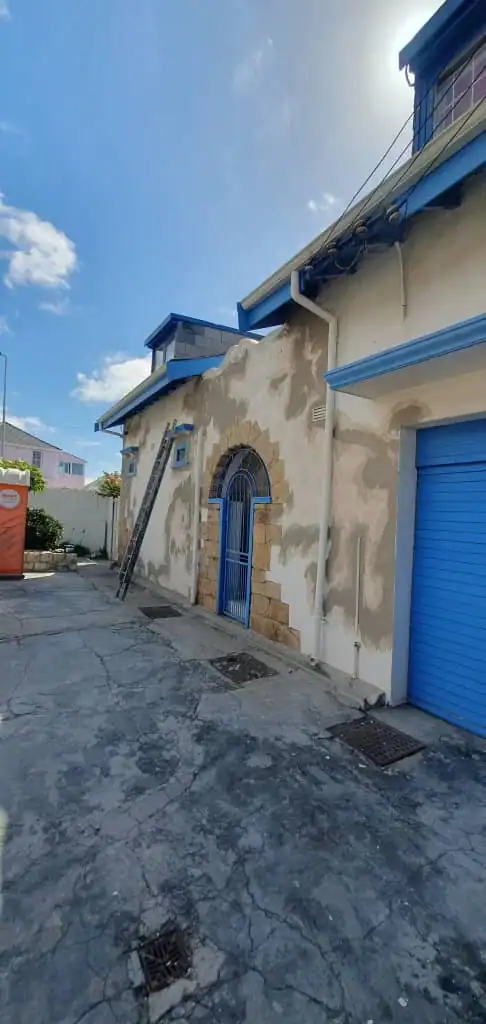
The house had reportedly last been painted approximately twenty years earlier. By the time of inspection, deterioration was visible across plastered walls, painted timber and steelwork.
The project therefore required a preparation-led restoration rather than simply washing the walls and applying two new coats of paint.
For our wider Muizenberg painting service, see Painters Muizenberg.
Why This Muizenberg Village Home Required Detailed Assessment
Older coastal buildings can accumulate several generations of paint, repairs, filler, sealants and weather-related deterioration.
A surface can appear reasonably intact from a distance while closer inspection reveals powdery coatings, poor adhesion, hairline cracking, failed joints, moisture-related discolouration and deterioration of timber or steel elements.
At this property the documented inspection identified:
- masonry moisture readings ranging from 19% to 37% WME;
- map or spiderweb cracking across plastered walls;
- cracks on vertical and horizontal masonry surfaces;
- cracked and vulnerable windowsills;
- failed sealant around windows and doors;
- unsealed expansion joints;
- horizontal surfaces requiring waterproofing;
- moisture-related discolouration and coating degradation;
- powdery and weathered paint surfaces;
- mould growth;
- peeling coating on fascia boards and other painted timber;
- deteriorating coatings and corrosion concerns on steel security gates.
19%–37% WME Moisture Readings
A Dulux paint specialist inspected the property and recorded masonry moisture readings between 19% and 37% WME.
Those readings were important evidence, but a moisture reading on its own does not identify one universal cause of damp.
The readings were considered together with the physical condition of the building: cracking, failed perimeter seals, open joints, exposed horizontal surfaces, boundary-wall conditions and visible moisture-related coating failure.
This distinction matters. A high reading does not automatically mean that every affected wall has rising damp.
Moisture can enter or migrate through masonry from several different routes, which is why inspection of the building fabric must accompany instrument readings.
A Dulux Paint Specialist Prepared the Project Specification
Because of the extent of the defects and the different substrates involved, a Dulux paint specialist inspected the property and prepared the detailed remedial painting specification.
The specification did not treat the house as one uniform painted surface.
Exterior masonry, damp-affected areas, windowsills, expansion joints, timber, steelwork and boundary walls each required preparation appropriate to their condition.
This is one of the reasons Painters Cape Town works with major paint suppliers where technical involvement is justified. A supplier specification can provide an additional layer of technical accountability where the existing coating condition or substrate requires it.
Any warranty applying to a supplier-specified redecoration remains subject to the supplier’s written specification, conditions, maintenance requirements and exclusions.
Cleaning Salt, Grime, Mould and Weak Existing Paint
Coastal exterior painting depends heavily on what remains beneath the new coating.
Salt residue, dirt, biological contamination, chalk and poorly bonded old paint can all form weak intermediate layers between the new coating and the building substrate.
The preparation specification therefore included thorough cleaning of suitable exterior surfaces, antifungal treatment where required and removal of remaining loose or poorly bonded coatings.
Hard paint edges created by coating removal were feathered to reduce visible ridges beneath the final finish.
Cracks Were Treated According to Their Size and Condition
Not every crack should be treated in exactly the same way.
The project contained both fine cracking and larger plaster defects. The specification differentiated between hairline cracks, wider plaster cracks and map cracking.
Wider cracks were opened where necessary, cleaned and repaired with compatible masonry repair materials before protective coating work proceeded.
Areas with widespread fine cracking required flexible preparation designed for the condition of the existing plaster.
Crack repair reduces an accessible moisture-entry route, but no painting system can guarantee that structural or movement-related cracking will never recur.
Expansion Joints Required Flexible Sealing
Expansion joints are deliberately intended to accommodate movement and should not simply be treated as ordinary static plaster cracks.
Open or failed joints at this Muizenberg project were therefore included in the flexible sealing scope.
Using rigid filler in a moving joint can result in renewed cracking as the building continues to expand and contract.
Window and Door Perimeter Seals
Failed sealant was recorded around windows and doors.
These junctions can become important moisture-entry points during Cape winter rain and wind-driven coastal weather.
Deteriorated sealant within the project scope was removed and renewed with a compatible flexible sealant where required.
Simply repainting the staining below a failed window seal would leave the accessible water-entry route unresolved.
Windowsills, Parapets and Horizontal Waterproofing
Horizontal masonry surfaces receive direct rainfall and can remain wet longer than vertical walls.
At this project, vulnerable surfaces such as windowsills and other exposed horizontal tops formed part of the waterproofing and preparation specification.
Dulux Rainshield formed part of the specified flexible protective treatment for applicable areas.
This type of preparation is particularly relevant in Muizenberg, where winter rain and coastal wind can drive water against exposed building details.
Damp-Related Preparation Was Targeted — Not Used as a Cure-All
Dulux Dampshield products formed part of the written specification for applicable damp-affected cementitious areas.
This did not mean that a coating was expected to cure every active moisture source.
Accessible cracks, failed seals, vulnerable horizontal surfaces and other water-entry defects needed to be addressed as part of the preparation.
Continuing moisture from inaccessible or unresolved building defects can still affect decorative coatings after repainting.
For more information about this approach, see our Damp Proofing Cape Town service.
Boundary Walls Required Different Expectations
Boundary walls can behave differently from the main house walls because they may have limited or ineffective separation from ground moisture.
The project specification specifically recognised that continuing moisture could migrate through certain boundary-wall masonry from below or behind.
This is an important limitation to explain honestly: a breathable or moisture-tolerant coating system may be the most practical treatment, but decorative paint cannot permanently prevent deterioration caused by continuing ground moisture where the building construction allows that moisture to migrate through the wall.
Painted Timber Required Its Own Preparation System
The home included painted fascia boards, sprockets, window frames and doors.
These surfaces could not be prepared as though they were plaster.
Loose and flaking coatings were removed, remaining sound coatings were sanded and hard edges feathered before exposed areas received compatible priming and finishing preparation.
Timber naturally moves in response to moisture and temperature, so joints and coatings on exterior timber should continue to be inspected as part of normal maintenance.
For broader residential repainting, visit Exterior Painters Cape Town.
Steel Security Gates and Coastal Corrosion
The project also included two painted steel security gates with deteriorating coatings.
Salt-laden coastal air can accelerate corrosion once the protective paint film has failed.
Loose coating and corrosion therefore had to be properly prepared rather than hidden beneath new finishing paint.
Exposed steel received appropriate anti-corrosive priming, including Dulux Rust Primer where specified, before compatible finishing coats were applied.
Why One Generic “Marine Paint” Would Not Have Been Enough
This project demonstrates why coastal painting should not be reduced to buying one product labelled for exterior or marine exposure.
The property contained:
- older plastered masonry;
- damp-affected cementitious surfaces;
- boundary walls with different moisture limitations;
- cracked windowsills and exposed horizontal surfaces;
- moving expansion joints;
- painted timber;
- painted steelwork;
- existing coatings of different ages and conditions.
Each substrate required its own preparation, primer or coating approach.
The Completed Muizenberg Village Exterior
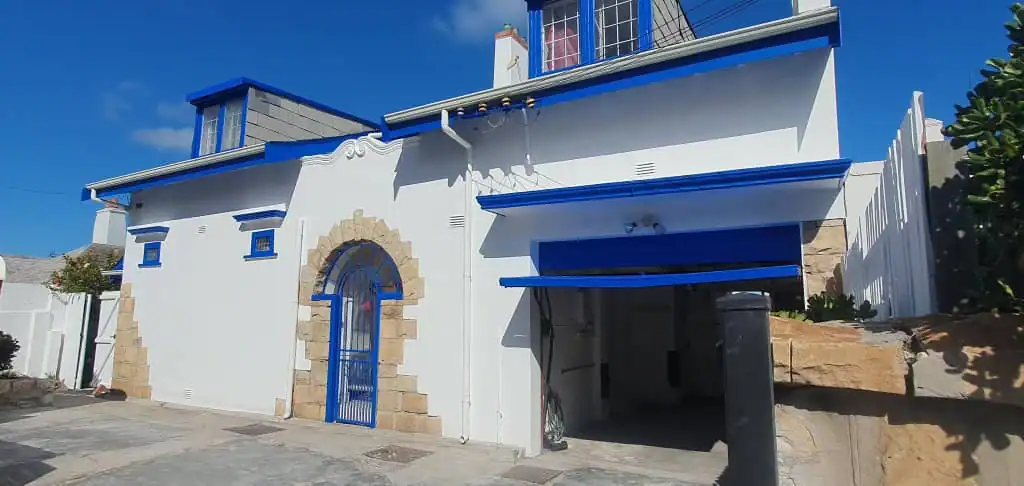
The completed building presented a consistent exterior finish after the defective coatings, accessible moisture-entry defects, cracks, joints, timber and steelwork included in the scope had been prepared.
The photograph also helps illustrate the scale and older coastal character of the property more clearly than the original written quotation alone.
Like any exterior property, the house will still require maintenance of seals, joints, cracks, waterproofed horizontal surfaces, timber and steelwork over time.
Future structural movement, renewed sealant failure, new cracking or new water entry can shorten coating life even where the original repaint was correctly prepared.
What This Project Demonstrates About Painting in Muizenberg
This genuine project is useful because it brings several Muizenberg maintenance conditions together in one property:
- older coastal building fabric rather than new plaster;
- a long previous coating cycle of approximately twenty years;
- 19%–37% WME readings rather than assumptions about damp;
- a formal Dulux specialist inspection and specification;
- different treatment for plaster, timber and steel;
- crack and movement-joint preparation;
- renewal of failed perimeter seals;
- horizontal waterproofing;
- recognition of boundary-wall moisture limitations;
- original preparation and completed-project photographs.
This is the preparation-first approach we use when inspecting properties through Muizenberg, False Bay and the wider Cape Peninsula.
Related Muizenberg and Cape Town Painting Services
Painters Muizenberg |
Exterior Painters Cape Town |
Damp Proofing Cape Town |
Residential Painters Cape Town |
False Bay Painters
Request a Muizenberg Painting Assessment
For an older home, sea-facing property, apartment building or other property in Muizenberg, we inspect the visible substrate and coating condition before preparing the scope of work.
Call 082 374 6862 or visit the Painters Cape Town contact page.
Helpful Painting Guides for Muizenberg Property Owners
Why Paint Peels, Fades and Cracks
Learn how damp, UV, weak adhesion, cracks, roofline defects and poor preparation can cause exterior coatings to fail.
Damp Walls and Repainting
Learn why failed waterproofing, cracks, boundary walls and other moisture routes should be assessed before repainting damaged coatings.
Planning a Professional Home Repaint
See how property protection, preparation, timber, glazing, paving and other finished surfaces should be managed during professional painting.
Muizenberg Village Exterior Painting Project FAQs
What type of Muizenberg property was painted?
The project involved an older double-storey coastal home in Muizenberg Village, Cape Town.
When was the project completed?
The documented exterior painting project was completed from 2 to 13 March 2026.
What moisture readings were recorded?
A Dulux paint specialist recorded masonry moisture readings ranging from 19% to 37% WME during the assessment.
Did the moisture readings prove that every wall had rising damp?
No. Moisture readings indicate moisture within the assessed substrate but do not by themselves diagnose one universal source. The readings were considered together with cracks, failed seals, open joints, horizontal surfaces and other visible building defects.
Was this a Dulux supplier-specification project?
Yes. A Dulux paint specialist inspected the property and prepared the detailed project specification before work proceeded.
How long had it been since the house was previously painted?
The house had reportedly last been painted approximately twenty years earlier.
What defects were found before painting?
The inspection identified map cracking, larger plaster cracks, failed window and door seals, open expansion joints, vulnerable horizontal surfaces, moisture-related discolouration, powdery coatings, mould, peeling timber coatings and deteriorating paint on steel security gates.
How were expansion joints treated?
Expansion joints were treated as movement joints and included flexible sealing where required rather than being filled as ordinary static plaster cracks.
Why did windowsills need waterproofing attention?
Windowsills and other horizontal masonry surfaces receive direct rainfall and can remain wet longer than vertical walls. Cracks on these surfaces can create moisture-entry routes into adjoining masonry.
Were timber and steel painted with the same system as the walls?
No. Plastered masonry, painted timber and steelwork are different substrates and required their own preparation, primers and compatible finishing systems.
Does the project automatically carry a blanket 7–8 year warranty?
No. This was a supplier-specified redecoration project. Any warranty duration, conditions, exclusions and maintenance requirements are governed by the written supplier specification issued for the project.
Who supervised the project?
Riaan supervised the project as the working foreman and assisted with painting while overseeing preparation and workmanship.
Were subcontracted painters used?
No. Painters Cape Town uses its own employed painting teams rather than subcontracted painting crews.
How do I request an exterior painting quotation in Muizenberg?
Call 082 374 6862 or visit the Painters Cape Town contact page.

Copyright 2026 , all rights reserved.